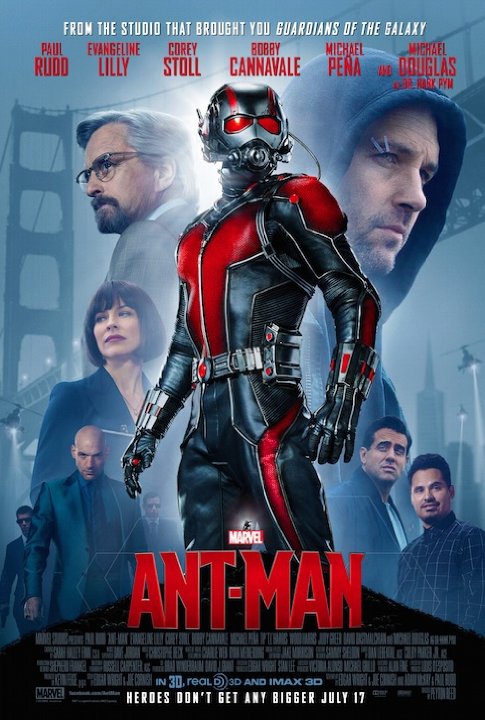
CGB Review of Ant Man

The following is an actual post on my personal Facebook page:

People of Facebook, I am in need. A huge task has fallen upon my small shoulders and it’s going to take more than the power of one to accomplish it…
I need you all to come up with jokes and puns for me to use in my CGB Ant Man review!  They have to involve shrinkage, small vs. big, uncles and aunts, being a “shrink” (therapist), any ant or aunt puns you can think of.
Just keep it clean and clever.
Now if you’ll excuse me…(puts on shrinking suit and runs off into the grand horizon).

My friends who did participate will be credited in this review using only their initials to protect their privacy.
This is my review of Ant Man!

“INCREDIBLE SCIENTIFIC POWER! …itty bitty living space.”
–J.S.

“Ant Man?  What, was Uncle-Man taken?” says R.L.  Alas, it is true; the titular character’s name is Ant Man, a small-scale hero taking on one big challenge.
Ant Man is, as said by J.L., “A small idea by Marvel, but made with big plans.”  It tells the story of Scott Lang, a savvy thief who just got done serving time in San Quentin for a robbery.  He is recruited by tech billionare Hank Pym and his daughter Hope.  Hank needs Scott to become the Ant Man and, I quote verbatim, “Break into some houses and steal shiz.”  The shiz in question is a shrinkage suit called the Yellow Jacket, which would be used in combat, but if made into copies and given to the masses, could spread chaos in its wake.  Scott, Hank and Hope have to steal the suit and destroy it in an orchestrated heist.

Witty banter is my favorite style of comedy, and Ant Man doesn’t disappoint.  Like Guardians of the Galaxy and the first Avengers movie, the humor in Ant Man is mostly dry, sarcastic banter between the characters.  Every joke is timed perfectly and the sarcasm is spot-on without becoming mean-spirited or unpleasant.  The movie is very self-aware and focuses on being a fun action comedy rather than going to dark-and-bruiting route.
This movie is particularly interested in the relationship between fathers and daughters, and this is displayed in the complex relationship between Hank and Hope Pym.  He doesn’t want to lose her, but fails to express this to her.  As a result, this makes her feel discounted and ignored by her own father.  The death of Mrs. Janice Pym haunts this fractured family.
Meanwhile, Scott’s motivations are driven by his love for his daughter Cassie.  In fact, interwoven into the film is a great message about rising above your past and being the best version of yourself.  Scott is reminded more than once to, “Be the hero Cassie already thinks you are.”  This is what pushes him to seek redemption and turn his life around so that he can be the knight in shining armor that his child deserves.

I only have two issues: For one, Darren Cross is not a compelling villain.  Actor Corel Stoll looks like he’s having the time of his life playing Darren Cross, but the actual character is not that intimidating.  He’s your typical evil corporate scumbag who wants to make millions and control the world and blah blah blah.
My second issue is that because this movie offers nothing new to the MCU (Marvel Cinematic Universe), it’s fun but forgettable.   Granted, mindless action has its place, but it’s kind of sad when a film doesn’t stand out.

Overall Ant Man is a small-scale popcorn flick and a welcome addition to the highly-successful Marvel Cinematic Universe.

Bad Animated Movies: CGB Review of Pup (2013)

So the dog character in this movie is described as a “sheepdog.”
Does this dog in the poster look remotely anything like a sheepdog to you?!
This is my review of Pup!

THAT'S NOT A FREAKING SHEEPDOG!
THAT’S NOT A FREAKING SHEEPDOG!

This garbage is the story of a lamb and a “sheepdog” who try to go to the moon while encountering a fashion designer wolf, Chinese spiders (I wish I was making that up) and other hijinks because…FLIPPIN’ POTATOES!  This autopilot script is so dull, so not-engaging that I had it playing on my laptop while I tidied my room.  Clearing off my desk was more entertaining than sitting through this flick.

The animation is awful.  They use the same curly design for the trees and sheep wool, the colors are bland and pasty, the animals range from mediocre to just plain ugly, and of course Kanuto the “sheepdog” looks nothing like a sheepdog!
Why does this get on my nerves?  Because THIS is a sheepdog:

My Old English sheepdog Sophie 11/10/99-5/11/15
My Old English sheepdog Sophie
11/10/99-5/11/15

I understand that the movie’s budget would make a pack of gum look expensive, but at the very least they could have tried to make Kanato resemble a sheepdog. Just slap some curly fur on his body, make him a Sheltie or a Polish lowland; do whatever you need to do.  There would be no problem if they just said “herding dog” or just “a dog.”  But if you label a dog character’s breed, then you’ve got to draw him/her that way.

Then again, no effort went into this horrid mess at all.  The voice acting is lifeless because every actor sounds like they’re either daydreaming or half-asleep…or both.  The jokes are dead on arrival, the “story” feels ad-libbed with no creativity, and the music…argh, the background music is just annoyingly ear-bleeding; there’s a scene where Kanuto is running to find Blackie and they have this bouncing sound effect accompaning his running.  I titled my head and said to myself, “Um, you do know he’s not hopping, right?” Then I remembered that the filmmakers didn’t care and I didn’t care, so I went back to organizing my bookshelf.

I’m just end this review with accurate pictures of the sheepdog family, which are more enjoyable to look at than this shizzy movie.

Belgian sheepdog
Belgian sheepdog
Polish lowland sheepdog
Shetland Sheepdogs (Sheltie)

Pray with the Colors of the Wind: Saint Kateri Tekakwitha

Every time I hear someone say, “The Catholic Church is so sexist and prejudiced,” I always respond with, “You should come visit my church, Saint Kateri Parish. Our patron is a Native American woman who had a facial disfigurement and was even partially blind.”  The stunned silence that follows is priceless.

Now I can’t paint with all the colors of the wind, but I can tell you the story of Saint Kateri Tekakwitha!

Before Disney's Pocohantas, there was Kateri.
Before Disney’s Pocohantas, there was Kateri.

Okay, I know that this is a more glamorized depiction of her, but she really did have a scarred face and weak eyes.  Before I explain how that happened, let’s go back to the beginning.

Kateri Tekakwitha was born in 1656 in Auriesville, which today is known as upstate New York, so technically she is a New Yorker.  [DISCLAIMER: Get ready for some seriously hard-to-pronounce-words in 3…2…1] She was the daughter of a Mohawk chief and a woman named Tagaskouita, who was an Algonquin Christian.  In her day, small pox was the kiss of death.  If you had it, it was game over for you.  Only the most hardy souls survived, and among them was a four-year old girl.  When small pox wiped out her entire village, including her parents and younger brother, the little girl was adopted by her uncle, an Iroquois chief who was disgusted by her scarred face and poor vision.  As a result, he gave her the derogatory name Tekakwitha, which means, “she who bumps into things.”  The scars on her face made her less attractive to potential suitors, so her uncle felt the need to arrange a marriage for her at the tender age of eight.

In her day, Jesuit missionaries were frequent visitors to that territory due to their mission to convert the Native Americans to Christianity.  As a child, Tekakwitha often had exposure to the words of the humble yet passionate missionaries.  She was moved by the promise of Salvation, and in particular, the emphasis on God’s deep love for each human being.  “Even me,” she probably thought as an outcast in her own tribe.  This led her to open her heart to a God who would accept her when no one else would.  Keep in mind that her mother had been a Christian, so faith was weaved into her youngest memories.  It was the message of the missionaries that has reawakened the faith of her childhood.  Nature was where she felt closest to the Creator, for she would make a cross out of sticks and pray among the trees and woodland creatures.  However she couldn’t be baptized just yet because, well…

In 1666, the Mohawk’s strongholds on the south bank were demolished by a group of French soliders and hostile Natives from Canada.  Tekakwitha and the remaining Mohawks crossed over the north side of the river and sought refuge in a village called Fonda where, at the age of 18, Tekakwitha was baptized into the Roman Catholic Church in secret and took the name Catherine, also known as Kateri.

There was just one major problem: Her uncle was not only repulsed by her, but like Professor Radisson in “God’s Not Dead,” he loathed Christianity.  So when he learned that his niece had become a Christian, he only accepted her decision under the condition that Kateri never leave their tribe.  The Iroquois people may have tolerated her facial disfigurement and blindness before, but now that she was a Christian, the gloves were off and she was made a pariah.  Public ridicule, scornful neighbors, false accusations; Kateri was at the center of the mob mentality.  Yet she never caved or recanted her faith in Jesus.  If anything, the rejection and hate from others only made her stronger.  It assured her that she was on the side of Truth.

Two years after her baptism, Kateri was forced to flee after her life was threatened. She escaped to the Mission of St. Francis Xavier in Caughnawaga, Canada, where she lived with fellow Natives who had converted to Christianity.  She spent the last years of her life here, where she dedicated her days to prayer, self-mortification and acts of charity.   On April 17, 1680, twenty-four year old Kateri Tekakwitha drew her last breath after suffering from a grave illness.  Upon the entrance of her soul into Heaven, the scars on her face faded away, revealing the true beauty of who she was.

On October 21, 2012, Kateri was canonized after prayers to her miraculously healed Jake Finkbonner, whose life had been on the line due to a flesh-eating virus.  She became the first Native American to be declared a Saint.

I think that certainty was Kateri’s defining characteristic.  She was certain that Jesus is Truth.  She was certain that her countercultural faith was worth the scorn of her tribe.  Christianity had empowered her to remove the blanket from her scarred face and shine with the Light of Christ for all to see.

Saint Kateri Tekakwitha, patroness of my home parish and of Catholic Girl Bloggin’, pray for us.

CGB Review of Serena (2015)

I just realized that this is Bradley Cooper’s fourth appearance on Catholic Girl Bloggin’ (see my reviews for Aloha, American Sniper and Silver Linings Playbook). I swear that’s a coincidence, though it doesn’t hurt to see his chizzled face and those baby-blue eyes more than once.

Before I ramble on about my crush on Bradley Cooper, this is my review of Serena!

serena-jennifer-lawrence-bradley-cooper-i
These two have insane chemistry.

Serena tells the story of timber industrial tycoon newly-weds George and Serena Pemberton.  The film chronicles their passionate marriage, the rise of their logging business, and their inevitable downfall as George must reconcile with his past that involves an illegitimate child with a worker and Serena must cope with a devastating event that shakes the foundation of their love.

So this movie has a very shaky production history.  Long story short, the filming finished up in 2012, but director Susanne Bier took more than eighteen months to edit and polish the final product.  It was submitted to a film festival in London, and then it bombed at the UK box office.  Finally it got picked up by Magnolia and had a limited theatrical release and a VOD (video on demand) slot.  There’s a reason I bring this up, but I’ll come back to that in a bit.

I’ve watched this movie twice; once in a hotel and last night on Netflix.  This film is like Courageous; there’s a lot of good stuff here and there’s also quite a few hiccups.

The Hits
I think it’s safe to say that Bradley Cooper and Jennifer Lawrence should keep doing movies together.  Their performances show that they enjoy each other’s company and love working side by side.  I like that the movie shows us that George is enamored with Serena without having other characters tell us outright, “She fascinates him, can’t you tell?”   The first act shows us how ideal their marriage is; George is tender with her and respects her intellect.  Serena stands by his side and works with him as a competent business partner.  Their relationship is centered around their admiration of each other and the combining of their goals.  Think Ella and Prince Kit from the live-action Cinderella movie if they ran a business together.  The movie succeeds at being an observant character study of George and Serena, these two people who think the world is theirs only to have it come crashing down on them.  All of the performances from the likes of Toby Jones and Rhys Ifans are top-notch, but it’s Cooper and Lawrence who bring home the bacon.  I will admit that after they were so electric as Pat and Tiffany in Silver Linings, it was a little jarring to see Cooper and Lawrence giving subdued performances.  However J-Law is believable as the capable, steeley feminist Serena while Cooper brings out his American Sniper chops as George, a once self-serving man who is softened by his marriage.

The Misses
So what holds this movie back?  Remember what I said earlier about how the director took more than 18 months to finish editing and what not?  Yeah…it starts to show in some of the transitional shots.  After George and Serena first meet, the film cuts to a faraway shot of people dancing, then it just cuts to a close-up of Serena’s smiling face, then it just cuts to her and George consummating their marriage.  Now I’m no film editor, but some of the transitions could have been smoother.  Also because a lot of the actors are attempting late-1920’s North Carolina accents, the audio of their dialogue is hard to hear every once in a while. Finally my biggest issue is that this movie is very, very slow.  Now there is a grace to a movie that is slowly-paced; you get to know the characters more intimately and the movie is allowed to create atmospheric tension.  However the downside is that because the story is taking its sweet time, the conflict that arises lacks a sense of urgency.  I wasn’t invested in the Pemberton’s money troubles or even when one character named Buchanan turns on George because the slow-pacing makes the conflict lag.

Putting aside the techincal flaws, I don’t think Serena deserved the scatching reviews it got from critics.  If I had to rank the four Bradley Cooper movie I’ve reviewed, it would look like this: Gold medal goes to American Sniper, Silver Linings gets the Silver (ba boom pssh!), Serena is given a generous Bronze, and Aloha gets…NOTHING AT ALL!

Saints Felicity and Perpetua, pray for us.

CGB Review of Bad Teacher (2011)

So this is gonna be a short review because it’s almost midnight and I’m tired.  However I can tell you right now that this movie isn’t getting a passing grade.

This is my review of Bad Teacher!

Behold, a stale comedy starring Cameron Diaz.

Okay, the misadventures of an obviously unqualified teacher is an interesting premise.  Cameron Diaz’s character Elizabeth is an amoral, self-serving teacher who thinks everyone is enamored with her; that is a creative arch that can be done well.

Unfortunately the writers of this movie were clearly not ready.  The script has a good set-up, but that’s where the creativity ends.  Cameron Diaz does what she can, but batting your eyelashes and sashaying down the halls isn’t character development.  I’m sure she’s very talented, but for a supposedly raunchy teacher, her performance becomes very constrained in the second half.  The same goes for the other actors; Phyllis from The Office only has to say lines awkwardly.  Justin Timberlake looks uncomfortable in his role half of the time.  Jason Seigal, you were in HIMYM; you can do better!

And then there’s Lucy Punch…argh!  I’m sure she’s a funny and talented woman, but holy cow, she is too annoying to put up with.  Obnoxious characters are supposed to annoying the other characters, NOT the audience.

I’m giving Bad Teacher, the stale and half-baked comedy, a D-.

Christian Movie Reviews: God’s Not Dead

I’ve been getting requests to review this movie since Day 1 of Catholic Girl Bloggin’.  When I started this Christian Movie Marathon, I knew I couldn’t bypass this one.

Without further ado, this is my review of God’s Not Dead.

gods-not-dead-fight
The fight is on.

God’s Not Dead tells the story of Josh Wheaton, a college student who must defend his Christian faith to his philosophy class after refusing to sign a paper with the words “God is Dead.”  He must go up against Professor Jeffrey Radisson, an avowed atheist who forces all the students on the first day of class to sign the “God is Dead” declaration.

I am pleased to announce that this movie is leagues better than Christian Mingle The Movie and Last Ounce of Courage.  However here is my current ranking of Best Christian Movies so far: #1. Grace Unplugged; #2. Soul Surfer; #3. God’s Not Dead.  I will highlight the hits and the misses:

The Hits

I love the rivalry that emerges between Josh and Professor Radisson, and that’s probably because I like rivalry stories.  The scene where Radisson confronts Josh in the hallway and basically tells him that he will ruin him if he continues his arguments is actually kind of terrifying thanks to Kevin Sorbo’s committed performance as Radisson.  My favorite scene between the two characters is the final debate in the classroom.  Josh begins making more personal jabs at Radisson, which keep his character from being completely virtuous.   In turn, we sees Radisson’s composure begin to crack until he finally succumbs to Josh’s emboldened stance.

I found Radisson to be the most compelling character, if not one of my favorite villains.  In fact, I kind of wish the story was told from his point of view.   This is a guy whose disbelief comes from a place of pain.  His atheism is a cover to mask his hatred for God.  He hides behind his intellect to keep his vulnerabilities from coming to light.  Something that my Mother pointed out is that Radisson keeps his relationships superficial; he chooses a circle of shallow intellectuals over deep, personal connections.  The one meaningful romance in his life (his relations with a Christian student named Mina) is one that he puts limits on.  Yes, I will admit that he did come off as the militant atheist stereotype, but I still saw a fully-realized character who undergoes a personal journey that comes full circle in the end.

Alongside the main storyline, there are two subplots: A Muslim girl named Ayisha who is secretly practicing Christianity, and an atheist blogger named Amy whose life comes crashing down after she learns that she is dying from cancer.  Their stories were well-written and could have been their own movies.  The movie never takes any jabs at Islam; in fact there’s one scene where Ayisha’s father tells her, “I know it’s hard to be set apart, but no one here worships God the way He should be worshipped.  You know I love you, Ayisha…” I thought that was a very respectful, human moment.  The scene where her Christianity is discovered and her father kicks her out is a powerful scene.  I appreciate that the father hesitates before kicking her out because it shows that he is torn between his love for his child and his commitment to his own faith.  Meanwhile Amy’s story is a little shaky at first, because she starts off as more of a “militant atheist” caricature than Radisson, but right after the cancer diagnosis, her character begins to develop.  I like when she says, “I don’t have time for cancer” because it tells us that time is the antagonist of her narrative.  I got choked up when the doctor asks, “Is there anyone you would like with you when I tell you this?” “No…there’s no one.” Minutes later the doctor leaves and she’s left sitting in the room, completely alone.  The movie lets the silence of the moment tell us of her pain, and that is more powerful than ten lines of dialogue.

The Misses

What did I say in my review of Christian Mingle The Movie?  (Goes back to the archives) “Yes, I believe that inner peace comes from faith in Jesus, but Christians are allowed to express more than one emotion” (Christian Movie Reviews: Christian Mingle The Movie).  The African preacher Pastor Jude annoyed me.  He was way too happy.  I have nothing against joyful Christians, but even the most joyful and content people can get stressed when the third car from the dealership won’t start.  His friend Pastor Dave is more believable in the situations they find themselves in.   I get that Pastor Jude has an unshakable trust in God, but joy and blind optimism are two different things.

You know how I had so much to say about the peaks and valleys of Professor Radisson’s character?  I wish I could say the same about the main protagonist Josh Wheaton.  Having a character start out as a blank slate and then having him/her progress over time is all fine and good, but when we first meet Josh, his own personal relationship with God is unknown, so his motivations for accepting Radisson’s challenge feels more like a command from the script than an organic decision made by the character.  Also I would like to add that only one person was against his accepting the challenge, and that was his awful girlfriend.  This problem would have been solved if his family knew and were trying to change his mind.  Even better, what if the girlfriend had been Radisson’s daughter?  Don’t be afraid to raise the stakes!   Now to be fair, Josh’s character does evolve especially in the final debate, which is his best moment.  Still I can’t overlook the weak starting points of his arc.

Let’s talk about the ending!  There’s a major spoiler ahead, so if you’re planning on watching the movie, then here is your warning:

[SPOILER ALERT!!!!  5…4…3…2…1] I might be in the minority here, but I really wish that Radisson’s acceptance of God as he is dying was left ambiguous.  As he is dying from internal bleeding, Pastor Dave asks him if he accepts Jesus as his Lord and Savior.  Radisson converts with his last breath.  Though this is how his character comes full circle, which I appreciate, but there is power in the ambiguous ending.  I feel that if Radisson would have died before verbalizing his conversion, it would have given viewers the ability to debate amongst themselves what his decision was.  Given the evolution of his journey, he could have gone either way (accepting or rejecting God).  Ambiguity keeps the viewers coming back for more.

Overall I am happy to say that this movie proves one thing: God and good filmmaking are not dead.  They are very much alive.

Christian Movie Reviews: Last Ounce of Courage

On the back of the DVD, there’s a quote from Chuck Norris that reads, “This is a wonderful family film to watch time and time again, as we have in our home.”

Chuck, you’re the epitome of manliness, but you don’t know jack shiz about good cinema.

This is my review of Last Ounce of Courage!

lastounceofcourage
Riding off into the sunset of bad cinema.

I waited to go into rant mode in my “Christian Mingle The Movie” review, but this whole review is going to be a rant, so here we go:

(Commencing Rant Mode) It’s generally not a good sign when I’m already hitting my face with my movie review notebook (yes, I have one of those cause I like to take notes during a movie) within the first five minutes of a movie.   This movie has a MAJOR structural issue, and that’s made evident in the first five minutes.  The opening scene is filmed as if it were the climax; fast transitions, jump cuts from characters aboard to characters back home, letter-reading voiceovers that have characters saying things that the movie expects us to know about them, even though we’ve just met these people.   Intense openers have their place in movies, but man, it can really kick you in the keister when executed poorly.  On top of that, you’ll notice very quickly that a lot of scenes look like they were edited by a French Revolution executioner with a butcher knife.

I don’t normally criticize character name choices, but holy cow, when your good guys are named “Bob Revere” and “Christian,” and you actually name your antagonist “The Hammer,” that tells me that the filmmakers see these people as props for an agenda, not characters to be fleshed-out and developed.

The narration…Good Lord, the voiceover narration is the reason why the main character is unable to give a good performance.  His whole personality and all of his motivations are explained to us heavy-handedly.  “I had been passive for too long.  My son died for freedom and I had to take a stand…” Gee, Bob, I sure would have loved to have seen this conveyed from a thoughtful performance instead of being spoon-fed to me via narration.

Speaking of character motivations, the people who don’t get voiceover narration just do things out of nowhere.  For instance, when Bob’s son Thomas is killed in Iraq, his daughter-in-law Kari just leaves the family because….the Illuminati!  Then fourteen years later, Kari and her teenage son Christian visit them out of the blue because…unicorns!  Where Grace Unplugged allowed the characters to be believable, Last Ounce of Courage uses each character as a pawn, so this restrains all of the actors from giving any kind of performance.  Also because all of the characters are agenda props, they’re never given realistic motivations or personalities.  Even the poorly-paced Courageous understood proper character development!

As a happy little Independent (I’m Purple, da ba de da ba die), I have nothing against FOX News.  I don’t think they should be compared to Hitler, but they’re certainly not the Messiah of the journalism world.  With all that in mind: This is the kind of movie that FOX News would make.  Every. Single. Line. Of. Dialogue is a red-state talking point, every character fits into the “Conservative Christian White Male” Bible-belt stereotype, and the “save Christmas” ascept is shoehorned into the story with little to no personal connection to the protagonists’ lives.

Religious liberty is an issue in this country (leave Hobby Lobby alone!)  Anyway, this movie intends to tackle this issue, but an incoherent script, constrained acting and preachy, in-your-face dialogue is not going to compel anyone to take the Religious Freedom movement seriously.

Saint Thomas Moore, pray for us.

Christian Movie Reviews: Grace Unplugged

Hey Christian filmmakers, if you want to save the genre, this is the movie you need to imitate.

This is my review of Grace Unplugged! Grace-Unplugged

Grace Unplugged is a family drama that centers around Grace Trey and her father Johnny Trey, a former rock star turned music minister.  The opening scene tells you (very subtly) that though they play in the church band together, there is tension between musical talent Johnny and the equally talented Grace.  When Johnny’s old manager Mostin tries to get him back into the secular music world, Johnny politely declines, but Grace goes behind her father’s back by sending Mostin a demo of her singing.  She enters the world of secular music and is given a new identity as Gracie Trey.  However her inability to write her own songs and the rift she has caused within her family hinders her path to stardom. Aj Michalka gives an impressive and sincere performance as Grace.  Though at times she tends to rely on the “deer-in-a-headlights” look in the second act, her facial expressions convey the protagonist’s inner turmoil.   Aj Michalka portrays a frustrated girl who expresses herself through music and just wants to be free to create.   James Denton plays Johnny Trey, and he gets the most transformation as a character.  I hated him in the first half because of how uptight and overbearing he was, but his journey into humility made him more sympathetic until I finally gave in and changed my mind about him.  This movie succeeds at having both Grace and her father learn a lesson; Grace learns not to throw herself into a world that she’s not ready for, and Johnny sees the error of his suffocating Grace’s talent. The film does a great job at not letting the message clash with the story.  The humanistic script allows the characters to be living, breathing people and not become Bible-belt stereotypes.  The God-dialogue sounds like it’s coming from the characters and not part of an agenda.  The filmmakers understand that our God is not a forceful God, so they avoid forcing His role in the story.  By allowing God to be in control without shoving Him into clumsy dialogue, the moral that God is in control is able to flourish in a natural progression. People, this is a freaking good Christian movie.  It’s a believable family drama, a well-thought character study of Grace and Johnny, and the music is pretty awesome.   I’m gonna go ahead and say it: Grace Unplugged and Soul Surfer are the movies that are going to save the Christian movie genre if filmmakers follow their example.   There is hope for this genre, and it’s movies like Grace Unplugged that are going to lead the way.

Saint Cecilia, pray for us.

CGB Review of The Babadook (2014/2015)

[Disclaimer: The Babadook was released in Australia last year, and got a DVD release here in the U.S. in April of this year, so that’s why it gets the “2014/2015” in the title]

So I had planned on watching this movie with the lights off, the volume at 100 and wearing my ear buds…By the second half of the movie, the lights were back on, my ear buds were off and I had placed four saints statues on my laptop while clutching onto a crucifix.

This is my review of The Babadook!

No, seriously, don't let him in!
If it’s in a word or it’s in a look, you can’t get rid of the Babadook.  So make sure you have a Vatican exorcist on speed dial.

Guys and gals, this is gonna be a tough review.  I had to discard the notes I had written while watching the movie because they just didn’t do my real thoughts on the film justice.  The Babadook is virtually perfect, and incredibly harrowing at the same time.  An opening scene that will leave you speechless, great scene transitions and a tense, sorrowful atmosphere bring this movie to Pan’s Labyrinth level of greatness (and yes, I will be reviewing Pan’s Labyrinth in the near future).

Give Essie Davis an Oscar right now. She is devastating as Amelia, one of the most miserable movie characters in recent memory. Amelia Vanak is a glassy-eyed widow whose husband was killed in a car accident while driving her to the hospital to give birth to their troubled son Samuel. Barely functioning with weary eyes and unkempt hair, the grief she carries and the weight of her stress over her wild child is made palpable to the audience.

Noah Weiman plays the little boy Samuel, and as a preschool teacher in real life, I can say that he nails his role as a hyperactive, out-of-control child.  I thought his character was well handled to where I could never hate him because his misbehaving is never intentional.  The film is very clear that he thinks that by making slingshots and dart shooters (out of wood, by the way), he’s protecting his mother from monsters.  He is legitimately unaware that he is the cause of Amelia’s misery.

I don’t issue trigger warnings often because I feel our society will find any reason to use trigger warnings, but this is one of those times where a trigger warning is necessary.   So here are my reasons for the trigger warning.

#1. If you have or are currently experiencing grief, I would urge that you proceed with caution if you plan on watching this.   This movie understands grief so well that it hits too close to home.  I say this as someone who has experienced grief.  I recently lost Sophie, my Old English sheepdog who I’ve had since I was a little girl. I used to watch movies with her sitting in front of the TV.  She would just lay there and let me pet her while listening to me rant at bad movies and praise the good ones to high heaven.  It’s only by the grace of God that I’m still able to sit through a movie at home without Sophie’s paw on my leg.  The Babadook is unflinching in its acknowledgment that when you’ve lost a significant figure in your life, the next few days, months and years are riddled with confusion, emptiness and even the sense that you’ve lost your own purpose.

#2. Speaking of pets, thank God for IMBD’s parental guide.  I knew I was in trouble when I read that a dog has its neck snapped.  If you’ve recently lost a pet (primarily a dog), then it might not be the right time for you to watch this.  I couldn’t watch the actual scene of when the dog is killed.

#3. IMBD’s parental guide mentioned that the movie might send triggers to anyone who has experienced childhood abuse, and that warning is warranted.  The scene where Amelia holds a knife in front of Samuel while she verbally attacks him is disturbing even if you’ve never suffered abuse.  Like in Silver Linings Playbook, the characters are well-written and fully realized that I became distressed for them when things go to Hell.  Also the toxic, codependant relationship between the weak-willed Amelia and the unpredictable Samuel might bring back memories for people who have been in that kind of relationship.

That all being said, don’t let those warnings deter you from The Babadook, a movie that tackles grief and the challenges of raising a troubled child with tact and grace.  (Hears a “baba baba dook dook dook” knocking at the door) Now if you’ll excuse me, I gotta go throw holy water at my door to keep Mister Babadook away.

Saint Rita of Cascia, pray for us.

Putting A Hashtag On Human Life

arguing-people-dreamstime-Darrenw (2)

Florissant, Missouri, June 24th, 2015

While speaking at a historic black church, presidential candidate Hilary Clinton spoke to the congregation about her mother, who became a maid as a teenager after being abandoned by her own parents.  All was fine and good…until this happened:

“What kept you going?” Mrs. Clinton had asked her mother.  She then explained that, “Kindness along the way from someone who believed she mattered.  All lives matter.

In another era, the last three words would have been well-received, wholeheartedly embraced by most people regardless of their political leanings. However, that is not the case in 2015.  It is all thanks to two simple hashtags: #AllLivesMatter and #BlackLivesMatter.

Southern California, June 24th, 2015

It was during my lunch break that I logged onto Facebook and found my newsfeed riddled with statuses and articles all concerning Mrs. Clinton’s use of “All Lives Matter.”  Blindsided by Internet activism, I took a breath and followed my natural instinct to investigate.  Once I had gotten the whole story of Mrs. Clinton’s debacle, I decided to look deeper into the two hashtags #AllLivesMatter and #BlackLivesMatter.

#BlackLivesMatter was a hashtag created after the acquittal of George Zimmerman in the 2013 trial centered on the killing of African-American teenager Trayvon Martin.  It was later revived after the death in 2014 of another African-American man named Michael Brown.  The purpose of #BlackLivesMatter was to tackle racial issues that continue to plague this country years after the Civil Rights Movement.  However, there is an opposing camp:  #AllLivesMatter, a hashtag created as a counter to #BlackLivesMatter.  Unlike the first hashtag, which emerged in 2013, the second hashtag entered the picture after the shooting of Michael Brown.

What I want to know is what is it about these two hashtags that fuels the flames of impassioned emotions in people?  Alongside this, a more disturbing question emerges in my mind: How did we get to this place where we as a society have to hashtag whose life is more important than the other?  If the value of a person’s life can be ranked from greatest to least, then we are all drowning.

Into The Minds of Two Movements

I’ve always felt that once you know the psychology of both sides of a conflict you can often get to the root of the problem, so let’s dive into the mindsets of these two opposing forces.

From what I have observed, the #BlackLivesMatter camp sees itself as champions for the African-American community.  They feel that the justice system treats this community unfairly, and the acquittals of George Zimmerman and Officer Darren Wilson have struck a serious blow to the black community morale.  I completely understand how the mother of a black son would be fearful for her child’s life in light of Trayvon Martin (age 17), Eric Garner (age 43), Michael Brown (age 18) and Tamir Rice (age 12).  Their issue with #AllLivesMatter is that it comes off as too broad and dismissive of the deaths of these three men and a young boy.

The #AllLivesMatter camp, which exists to counter #BlackLivesMatter, feels that the opposing camp is preaching that only one specific group of people is more important than others.  They see it as exclusory of other sets of people, and dismissive of situations where a white person is shot and killed by a black person, or an African-American is murdered by a Hispanic-American.  Anyone could be the victim and anyone could be the perpetrator.  They fear that by giving all the attention to one specific ethnicity, this raises the possibility of other racial groups being ignored.

When The Greater Good Is Forgotten

Any time I write about a controversial issue, I always ask God to point me to a Saint who is related to said issue.  Because this op-ed is about race and social justice, God guided me to Saint Martin de Porres, an interracial Peruvian monk who was the illegitimate son of a Spanish knight and a freed black woman.  During his time on earth Martin had experienced racism firsthand due to his mixed blood.   In spite of this, he was known for his compassion and humility, which was the driving force of his charitable deeds throughout Lima, Peru.  Because of his humble character, he never forgot the One he served and never let pride in his good works cloud his judgment.

I began to wonder, “What if Martin didn’t have the gift of humility?   It’s easy for a virtuous person to become aware of their accomplishments…” This thought led me to think about the modern heroes of literature and cinema (Harry Potter, Katniss Everdeen, Peter Parker/Spiderman, etc.) and how they never thought to themselves, “Oh, I’m such a hero!”  They were simply fighting for a greater cause.  What happens when social justice activists see themselves as heroes?  If someone thinks they are ahead of everyone else, it is easy to get comfortable and neglect self-improvement.

That was when I realized that comfort in the message can lead to corruption.  Most people would agree that discrimination is wrong and that every life matters, but too often the actions of activists betray the message.  As a result, in this case both parties (#BlackLivesMatter and #AllLivesMatter) have a public image problem.

#BlackLivesMatter is tainted by the images of looters during the Ferguson protests.  Because the loudest voices get the most attention, the media focused more on the looters than on the peaceful demonstrators.  While most of the looters just wanted to cause trouble, it is also possible that some of the looters were good people who started out as peaceful, but got caught up in the outrage and were blinded by their desire to fight a system that they felt had wronged their community.  Fueled by frustration, they chose a destructive path that was caught on camera.

#AllLivesMatter is tainted by its own inception: It was created for the sole purpose of opposing #BlackLivesMatter and had no further vision.  With the mindset of “Everybody agrees that all lives matter, so winning the public will be no problem,” this led to their camp neglecting to work toward a greater good.  Their lack of vision caused the hashtag #AllLivesMatter to be used by ill-informed people as a way to dismiss the concerns of the black community.  In turn, the #BlackLivesMatter camp went further on the offense and gave their opponents the ammunition they needed to portray the looters as the face of #BlackLivesMatter.

When two forces go to war with one another and lose sight of the greater good, social justice is reduced to fashionable controversies that are here today and gone tomorrow, resurrected in the public square only after the death of another unarmed black father/husband/brother/son/friend makes the headlines.  Does it take another tragedy to keep the productive conversation going?

#SomeLivesAreConvenient

Earlier I asked how we as a society came to this place where the value of human life can be ranked from greatest to least.  If the skirmish between #BlackLivesMatter and #AllLivesMatter has shown us anything, it is that the pyramid of who is convenient and who can be ignored has permeated American politics for a long time.  Every civilization goes through a period of establishing a human pecking order.  In our time this mindset couldn’t be more evident than by the two hashtags #BlackLivesMatter and #AllLivesMatter.  Both sides accuse the other of being dismissive of certain lives, but it is their fighting between themselves that keeps effective change from coming to fruition.

In a perfect world, these two camps could perhaps come together and say, “We both have a sound message, so why don’t we stop bickering with each other and go after the real enemy?” the real enemy being social injustice, even the human pecking order.   Unfortunately, after the Garden of Eden peace rarely lasts before conflict steps in.

Saint Martin de Porres did not fight poverty by creating hashtags and inflaming passions.  The will of God was his General, humility was his armor, and his faith by example was what brought hope to the desperate poor.   He did not champion certain types of people who advanced his agenda.  He served all.

Until we remove the price tag on human life, social justice will always be like a faucet that only pours out water when it suits an agenda.

Saint Martin de Porres, pray for us.

1 Corinthians 4:6, “I have applied these things to myself and Apollos for your benefit, brother, so that you may learn from us not to go beyond what is written, so that none of you will be inflated with pride in favor of one person over against another.”