When I started Catholic Girl Bloggin’, I chose my six favorite Saints to be patrons of the blog. One of those patrons is Saint Lucy of Syracuse. She came into my life when I was a senior in high school, and she has been my spiritual sister ever since. Lucy is the patroness of eye issues. She healed my mother when she had pink eye a few years ago. Last year, when I had a case of dry eyes, I prayed to Saint Lucy and in three days my eyes were healed.
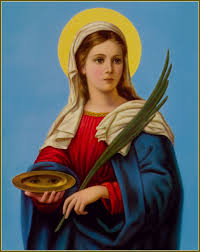
Saint Lucy was born in Syracuse, Sicily. She entered the world when the Roman Empire was in some serious shiz. Heads were rolling, and I do mean that literally because Christians were being executed left and right. Her father died when she was five, so her mother Eutychia raised her alone. Lucy embraced her mother’s Christianity and at a young age made a promise to Jesus that she would consecrate her virginity to Him. In other words, she would never marry and instead be a single bride of Christ for the rest of her life. However in her day, unmarried women were either left begging on the streets or taken captive by enemies of the Roman Empire. Out of fear for Lucy’s future, Eutychia did the only thing she could do: She arranged for Lucy to be married off to a young man from a wealthy Pagan family.
The turning point in Lucy’s life came when Eutychia learned she had a blood disorder. Lucy was able to convince her mother to make a pilgrimage to Catania, where the main attraction was the tomb of Saint Agatha (patron saint of those who suffer from breast cancer). As Lucy prayed at the tomb, Saint Agatha appeared to her in a vision. I’m just going to paraphrase how their conversation went:
AGATHA: Lucy, your mother will be cured, but you will be called to martyrdom.
LUCY: Just cure my mother, and I will do whatever He asks of me.
As Agatha promised, Eutychia was cured and after some persuasion from Lucy, she allowed her daughter to serve the poor and the family wealth was used to help those in need. As time went on, Lucy made a name for herself with her charitable works to the less fortunate, and later, her aid to Christians who were hiding in the catacombs. She would carry food and drinks to them, unaware of informants who sought to betray the persecuted Christians.
Now Lucy was known to have been very beautiful. She had striking eyes that sparkled with the light of Christ within her. I mention this because her former fiancee, the young man from the wealthy Pagan family, wanted her as his wife. But remember, she had made a vow of perpetual virginity to Jesus, so that wasn’t going to work. Also after her mother was cured, the betrothal had been called off. So the angry ex-fiancee went to Governor Pascasio. As a result, Lucy was caught and became a prisoner of the Empire. Her martyrdom took place in Syracuse’s magnificent amphitheater, where Pascasio sat along with politicians and general. It was Lucy vs. All of Rome.
I used to think of Lucy as a sweet, docile Saint.
I was wrong.
When she refused to worship the Pagan gods, Pascasio ordered that she be forced into prostitution. The Roman guards gathered to take her to the brothel, but to their surprise, her body was suddenly immovable. No, seriously, she was like a statue. More guards came to try and move her. Even a team of oxen was used to try and haul her, but the thin girl was now heavy as a boulder. By the power of Christ she was protected from the house of sexual sin. Pascasio’s next move was to have her burned at the stake. As she stood in a bundle of twigs, soldiers began to ignite the twigs, but they wouldn’t burn. Even when they were soaked with oil, no fire would come. As you can imagine, Pascasio was not happy being one-upped by a young Christian girl. In desperation, he ordered that her eyes be gouged out, which is why she is the patron saint of eye problems. As blood ran down her face from where her sparkling eyes used to be, Lucy did not scream or cry. She simply stood there, professing faith in Jesus Christ. It is said that her bravery and the miracles surrounding her inspired many Pagans to convert to Christianity. Lucy was then stabbed in the neck by a soldier. She had won the battle and went to Heaven as a victor on December 13th, 304 A.D.


 Catholic Girl Bloggin'