A Lamb Among Lions: Saint Agnes of Rome

Saint Agnes holds a special place in my heart.  She was the first Saint I ever learned about.
As a little girl, I remember being inspired by her strength and faith in Jesus.  Whenever a teacher asked me what I wanted to be when I grew up, I would reply, “I want to be like Saint Agnes.” As you can imagine, the response was usually a polite smile from the teacher and snickering from my classmates.
As a teenager, when it came time for me to pick a Confirmation Saint, Agnes was my very first choice.  Granted, the winner was Saint Monica, but I still consider Agnes to be my spiritual sister.  Honestly, if it weren’t for her, I probably wouldn’t have a devotion to the Saints in the first place.
Without further ado, I’d like to introduce you to my spiritual sister, Agnes of Rome.

8bc38818b3523be0b93fd06a07c3b438

In 291 AD, a Christian family of Roman nobility was blessed with a beautiful baby girl.  The child was named Agnes, which comes from the Latin agnus, meaning “lamb.”
Little is known about Agnes’ childhood, but what we do know is that she was very beautiful.  It has been said that she was graced with a cascade of silky hair that draped over her shoulders like a shawl and a tender smile.  By the time she was twelve, she already had a good amount of high-ranking men competing for her hand in marriage.
However, when she was approached by a potential suitor, her answer was always, “Jesus Christ is my only Spouse.”

As a child raised in a devout household, Agnes had come to know Jesus as her Savior.  In an era where daughters were married off for advantage and power, Agnes made a countercultural choice: She claimed Christ as her spouse.  Her body, mind and soul belonged to the One who created her.
Her commitment to Jesus did not go over well with the men who wanted her.  For example, a man named Procop saw Agnes’ purity as a challenge for him to conquer.  He showered her with flowers, jewels and the finest clothes.  He filled her ears with promises of power, wealth and pleasure.
Agnes fought back with this defense, “I am already promised to the Lord of the Universe. He is more splendid than the sun and the stars, and He has said He will never leave me!” Her body belonged to no man; only God.

Another rejected suitor was the son of Prefect Sempronius.  The Prefect himself tried to persuade Agnes to accept his son’s hand in marriage.  As expected, Agnes kept her eyes on Heaven and turned away from the prospect of earthly matrimony.
It is unclear who ratted her out to the authorities.  Some have guessed it to have been Procop, others say that Prefect Sempronius himself was the catalyst of Agnes’ demise.  What we do know for sure is that Agnes was arrested for professing Christianity.

Agnes was ordered to pray to the Pagan gods in exchange for her freedom.  Filled with resolve, she stayed faithful to her Spouse and refused to worship any other god.  The brave twelve-year old was thrown into a brothel to be violated.  When the men attempted to have their way with her, Agnes’ hair grew to an exponential length and shielded her body.  Within minutes, their lustful eyes were struck blind.  Some accounts have claimed that among the would-be rapists was Prefect Sempronius’ son and that Agnes healed him with a prayer.
The next trial Agnes faced was being stripped naked and burned at the stake.  Just like in the brothel, Agnes’ Rapunzel-esque hair cloaked her body.  Then when the soldiers tried to ignite the flames, the wood surrounding her wouldn’t burn.  This miracle shocked the onlookers and the sympathy of the citizens turned to Agnes.
It was a sword to the throat that brought an end to Agnes’ life.

In our modern world, people use “choice” as a buzzword for expediency.  Agnes, whose expedient choice would have been to give in to societal expectation, chose the more difficult path, one that led to great suffering and to Eternal Life.  In many respects, Agnes was a woman ahead of her time.

Saint Agnes of Rome, pray for us.

What We Stand For: A Brief Reflection on The Colorado Springs Planned Parenthood Shooting

newborn-3

I’m sure by now you have heard of the Planned Parenthod shooting that took place in Colorado Springs yesterday.  However, just for emphasis, I will summarize it:
At 11:38 local time, 57-year old Robert Lewis Dear burst into the Planned Parenthood clinic in Colorado Springs and opened fire. The staff and patients took cover in closets and bathrooms.
Police were engaged in a standoff with Robert Lewis Dear that some sources say lasted five hours while other sources state lasted for six hours. Officers continued to encounter gunfire as they evacuated the people who had taken cover.
The standoff ended when Robert Lewis Dear surrendered.

Since yesterday I have been taking to Facebook and joining the flood of pro-life groups and advocates who have been condemning Robert Lewis Dear’s act of violence against Planned Parenthood.  However, that hasn’t stop detractors from using this tragedy to blame pro-life activists and smear our cause.  For me, the biggest blow came when Buzzfeed posted an article entitled, “Some Abortion Foes Cheered the Planned Parenthood Shooting.”  http://www.buzzfeed.com/rachelzarrell/some-pro-life-supporters-cheered-planned-parenthood-shooting?utm_term=.uoAz1YPPe#.ggM0eMww9

After that, I just logged off and took some time to take a breath.  My heart was already heavy from what happened in Colorado Springs, and to see a cause I care for being slandered was even worse.
I went to our living room and sat in front of the Christmas tree, staring at the ornaments and lights.  “Why should I even bother?” I asked myself. Why should I even bother to keep posting about how pro-life groups have condemned what happened in Colorado Springs if people will continue to paint us as violent extremists anyway?
I looked at our pictures of Jesus and Mary that hang side by side on our wall. I bore my eyes into Jesus’ image, concentrating at his upward gaze, his purposeful expression.

Then, somehow, I came to a distressing thought: ‘Why did Jesus even bother to die on the Cross?’

I had to sit down.  Jesus died for our sins, but we still sin anyway, so why would He bother?
The answer: Because Jesus’ mission was to save us.

This conclusion lifted me from my drained state.  Why should I bother to be vocal about defending the pro-life cause?
Because defending every life is our mission.

What others say about us doesn’t matter.  How society paints us is irrelevant.  Pro-life does not exist to please others.  Pro-life exists to protect the dignity of every single life.

Pro-life means defending the humanity of the unborn baby.
Pro-life means reaching out to the single mother.
Pro-life means offering hope to the pregnant teenager.
Pro-life means supporting the rape victim.
Pro-life means showing mercy to abortion clinic workers.
Pro-life means feeding and clothing the homeless.
Pro-life means welcoming the refugee.
Pro-life means standing up for the death row inmate.
Pro-life means giving shelter to abandoned animals.
Pro-life means every beating heart matters.
I will say this as many times as I need to: Pro-life does not stand for violence or extremism.  We do not stand for shaming women or abortion workers.  You cannot call yourself pro-life if you do not condemn violence against clinics or the people who work there.  Oppose abortion, but do no harm to those who support it.

Pro-life is pro-peace.
Period.


CGB Review/Explanation of The Theory of Everything (2014)

Is it possible for a movie to be so gut-wrenchingly beautiful that it breaks you in the best possible way?

This is my review of The Theory of Everything!

The-Theory-Of-Everything-Images

The Theory of Everything is based on the memoir, Travelling to Infinity: My Life with Stephen by Jane Wilde Hawking.  In the 1960’s Stephen Hawking and Jane Wilde meet at Cambridge during a party.  They begin an intellect-centered friendship that blossoms into a romance.  However all seems lost when Stephen learns he has a motor-neuron disease (ALS/Lou Gehrig’s disease) at the age of 21.  In spite of this, Jane makes the decision to confess her love for him and becomes his wife, vowing to be his staunchest ally in the fight against his disease.

After watching the film, I have come to the conclusion that I cannot use my usual “Hits and Misses” system.  This is the first film I have seen that needs to be reviewed on an entirely different standard.   The reason for this is everything right with the film is objective and everything wrong with the film is subjective, a matter of personal taste.

The Objective Good
Good Lord, the lighting and cinematography is exceptional!  The opening shot of the film is a soft gold color pallate, while the night scenes are a lovely shade of turquoise.  There’s a great scene where Stephen is sitting alone, watching TV and the red color pallate expresses his inner turmoil over the diagnosis.
Eddie Redmayne won the Oscar for playing Stephen Hawking and frankly, he earned it.  His extraordinary physical performance is heartbreaking, while his vulnerablity and willingness to have other actors carry his body had me sobbing. Eddie Redmayne becomes Stephen, a lover of the sciences.  Fluent in physics and mathematical theory, he pursues an understanding of the structure of the universe with every fiber of his being.
Not only does Felicity Jones have the same gentle beauty as Lily James in Cinderella, but she is also as empathetic as Keira Knightly in The Imitation Game. In the Hawking marriage, Stephen is the head and Jane is the heart.  Felicity Jones brings Jane to life as an angelic flower with an iron will.  She knows what is at stake, but honors her vows by refusing to abandon her ailing husband for her own personal comfort.
If you love the piano and classical music in general, you will want to buy the soundtrack immediately.  The musical score here is just as great as The Imitation Game soundtrack.  It has an epic vibe, illustrating the marriage of Stephen and Jane as a daring, intellectual adventure.
In fact, if you are a fan of The Imitation Game, you might enjoy this movie, as well. The script is very intimate with Stephen and Jane, giving the impression that the director knows these two people personally and wants you to know and love them as much as he does.
I am going to go out on a limb here and recommend this movie to newlyweds and long-time married couples.  The Theory of Everything is the best portrayal of marriage I have ever seen.  It neither advocates nor argues against marriage; it only demonstrates the trials and triumphs that marriage entails in an honest, humanistic way.

The Subjective Bad
If you have endured the trauma of watching a family member decline, this movie will be a very difficult experience.  The deterioration of Stephen’s body is agonizing.  I had to take quite a few walking breaks.
One scene in particular shows Stephen trying to get up a flight of stairs while his toddler son Robert watches.  I don’t want to talk about it for too long, otherwise I’ll start crying again.  This scene is that painful.
Oddly enough, as the movie nears the third act, I found myself becoming desensitized to Stephen’s collapsing body until he gets pneumonia and ends up needing an operation that will make him unable to speak ever again.   My heart was broken in two all over again.
All that being said, to tell you not to watch this movie would be a disservice. Instead, I will advise that you exercise good judgment.  Know your limits in terms of what you can handle to see on screen and go from there.

Guys and gals, The Theory of Everything broke me in the most beautiful way.  I love it and I hate it all at the same time.  With inspired performances, wonderful music and an excellent script, The Theory of Everything is a tragically victorious story of how love really can overcome all obstacles.  This is an exceptional film that I never want to see again, but am sure glad that I gave it a shot.

Saint Jude, pray for us.

A Pro-Choice Argument That I Cannot Stand

ebhgsejyfg jkwebfjkb

I have been pro-life ever since I was ten-years old and my stance on abortion has only gotten stronger with time.  Even as a child, I could never wrap my head around the fact that there is a medical procedure that violently ends the life of an unborn human being.  Children are by no means perfect, but there is nothing they could do to deserve being dismembered or injected with saline to induce cardiac arrest.
However, I live in the magical land of California, which is more blue than a Dodgers baseball uniform.  This means that I have a plethora of pro-choice friends.  I have gotten into civil discussions about abortion with these friends, but it never gets nasty.  If people end a friendship over opposing views, then they were never friends to begin with.
To their credit, my pro-choice friends usually give me intelligent arguments as to why they feel the way they do about abortion.  They give me valid points that I keep in mind when formulating my own arguments.
I do understand that some women are in dire financial straits and cannot afford to care for a child.  I do understand that a pregnant rape victim is already dealing with enough trauma as it is.  I do understand that health complications in pregnancy are possible.  I understand all of these realities without accepting abortion as the lord and savior of women.

All that being said, there is one pro-choice argument that I do not understand. Every time I hear someone spout this argument, it is like nails on a chalkboard to my brain.
That argument is this:

“When does life begin?  I submit the answer depends an awful lot on the feeling of the parents.  A powerful feeling – but not science.”
–Melissa Harris-Perry

So in other words, if mom and dad say it’s a baby, then it becomes a baby.  If mom and dad don’t think that it’s a baby, it’s magically not a baby anymore?  Forget prenatal science and embryology; it’s the mighty power of wishful thinking that tells us when life begins.
In what universe does this make any sense?!  Okay, maybe it would make some lick of sense in freaking Asgard (Thor and Loki’s world), but not on planet earth.
If a pregnant woman went in for an ultrasound and then tried to wish away the baby by chanting the words, “I don’t think it’s a baby, I don’t think it’s a baby, I don’t think it’s a baby…” there would still be a baby on the screen/in her womb when she opens her eyes.
What baffles me about this argument is that it’s inapplicable in any other area of life.  In an intellectual debate about a pressing real-life issue, it makes no sense to use insane, out-of-this-world talking points that could not be put into practice in real life.
If I told my boss, “I know you want me to come in a 7 am, but I think my shift doesn’t start until I decide it starts,” my name would be wiped clean off the payroll.
If someone kills an animal and then says, “Well, it’s not an animal until I say it’s an animal,” would the judge say, “You know, he/she didn’t think it was a living, breathing creature, so it’s all cool”?  No!  That person’s keister would still end up in the slammer.  Oh, and PETA would be protesting outside the courthouse.
If someone is pulled over for drinking and driving, do you think the officer is going to let them go if the person says, “Gee, officer, I don’t think I’m inebriated…” even if their blood alcohol content is above the legal limit?  No, they would still be handcuffed and charged.
I’m sure Ms. Melissa Harris-Perry is a nice woman who is loved by the people in her life.  However, why would a grown adult with years of life experience resort to such a childlish argument?
Honestly, I think that this argument is pretty insulting to women.  This argument treats women with kid gloves, painting us as immature people who resort to make-believe as a defense mechanism.  Women deserve better than to be talked down to. Adult issues need to be handled with adult discussion, not talking points that one would expect from a teenager.

So when does life begin?  When the sperm and the egg come together in the Fallopian tube.  When the sperm enters the egg, the zygote is conceived.  The zygote already contains the entire genetic DNA of both mother and father; exactly 46 chromosomes (23 from mom and 23 from dad).
New research has shown that the heartbeat is present just 16 days after conception.
It only takes three weeks after conception/five weeks of pregnancy for the heart, brain and spinal cord to form.
On the seventh week of pregnancy/fifth week after conception, the face and nostrils are already present.
By the twelfth week of pregnancy/tenth week after conception, the unborn baby has fingernails and a fully-formed face.

It takes one man and one woman to create a new human being.  Feelings have no say.


“I do, as a humanist, believe that the concept “unborn child” is a real one and I think the concept is underlined by all the recent findings of embryology about the early viability of a well conceived human baby, one that isn’t going to be critically deformed (or even some that are) will be able to survive outside the womb earlier and earlier, and earlier and I see that date only being pushed back. I feel the responsibility to consider the occupant of the womb as a candidate member of society in the future, and thus to say that it cannot be only the responsibility of the woman to decide upon it, that it’s a social question and an ethical and a moral one.  And I say this as someone who has no supernatural belief.”
Christopher Hitchens

Sources:
http://www.dailymail.co.uk/sciencetech/article-3833015/A-baby-s-heart-beats-just-16-days-conception-Heartbeat-breakthrough-lead-new-cures-congenital-disease.html?ito=social-twitter_mailonline#ixzz4Mo5NDpB3
http://umm.edu/health/medical/ency/articles/fetal-development
http://www.mayoclinic.org/healthy-lifestyle/pregnancy-week-by-week/in-depth/prenatal-care/art-20045302
http://www.newhealthguide.org/When-Does-A-Baby-Have-A-Heartbeat.html

Dear Animal Rights Supporter…

Dear Animal Rights Supporter,
I come from the pro-life movement.  You come from the animal rights movement.

I fight for unborn children.
babyinthewomb2

You fight for animals.
Animal-Rights-animal-rights-13295974-600-431
We come from two different causes, yet we have more in common than you may realize.
It crushes you to see animals locked in cages so small that they can barely move.
It crushes me to see a dismembered infant tossed into the trash.
Your heart breaks for the abandoned dog on the side of the road.
My heart breaks for the unborn baby who will never live to know his/her mother.
You are outraged when emancipated tigers are forced to perform at the Missouri State Fair.
I am outraged when the latest Planned Parenthood video shows a worker carving open an unborn child’s face to harvest the brain.
You understand that owners often leave their pets behind because they are unable to take care of them.
I understand that women often turn to abortion because they have no one else to help them.
You believe that the disowned cat deserves adoption, not abandonment.
I believe that the unwanted child deserves adoption, not abortion.
Society defines both the animal and the unborn baby as property that can be discarded if they are an inconvenience.
You and I disagree.
Adoption is the loving option.
You and I agree.

Our movements have the power to create a culture of life.  A culture where no human or animal is reduced to a replaceable commodity.  A culture where all lives are valued equally.  A culture where every life is given dignity.

There are differences in our movements, but if the pro-life movement and the animal rights movement were to focus on what unites us, if we were to combine causes, we would be an unstoppable force to be reckoned with.

Every beating heart matters.

Saint Gianna Beretta Molla and Saint Francis of Assisi, pray for us.

A Mother’s Love: Saint Monica

I was sixteen-years old when I was going through the Confirmation program. When it came time for me to pick a saint, I was torn between all the single saintly ladies: Teresa of Avila and Catherine of Siena were my top picks, but so were Agnes of Rome, Maria Goretti, and Cecilia.  Joan of Arc is cool, but Lucy of Syracuse is like a sister to me.  Then there’s my parish patron Kateri Tekakwitha to consider, but then again, Faustina Kowalska is the patroness of the Divine Mercy!  AAAAHHHHH!!!!
As you can see, I was quite stressed.  So many awesome ladies to choose from and I only had so much time.  I remember flipping through my Saints book in a panic.  I ended up dropping it and watched it cracked open on the tile.  When I picked it up, I saw the page on Saint Monica.
I skimmed through her chapter, “She doesn’t seem very interesting.”  She wasn’t a soldier like Joan or a martyr like Lucy, Maria or Agnes.  I put Monica on the backburner for a while.
However, the longer I resisted, the more she crept up on me.  One night I went online and read up on Monica.  I scratched my head, “God, why should I pick her?  We have nothing in common.”
At first glance, Monica and I were incompatible as candidate and patron.
She was a married woman.  I am single.
She lived in Africa.  I am a born-and-raised California girl.
She was an obedient old woman.  I am a headstrong young woman.
In spite of all these differences between us, I couldn’t bring myself to click out of her info page just yet.  So I sighed and took a second look at her story.

Saint Monica portrayed by actress Monica Guerritore in Restless Heart.

Saint Monica was born in 331 AD in Tagaste, which is now known as Souk Ahras, Algeria.  Not much is known about Monica’s childhood, but we do know that she was born after Constantine legalized Christianity.
You may have noticed that in a lot of my Saints bios, many of these guys and gals were either in arranged marriages (ex. Cecilia) or were arranged to be married to somebody (ex. Lucy).  Monica is no exception.
She was twenty-two (a year younger than me) when she was betrothed to a Pagan man named Patricius.  By all accounts, Monica was a generous and obedient girl, so she was married off without hesitation.
To put it simply, Monica got a pretty raw deal because Patricius was the biggest jerk in Tagaste.  Violent, with an explosive temper, he verbally and physically abused Monica during his outbursts.  To add insult to injury, he was the kind of guy who would be a regular Ashley Madison customer if he lived in the year 2015.  Oh, and did I mention that his mother/Monica’s mother-in-law also worse than Nurse Ratchet from “One Flew Over the Cuckoo’s Nest?”  Needless to say, the apple didn’t fall far from the tree.
Now, you’re probably thinking, “Ditch this guy, Monica,” but divorce court wasn’t a thing in AD Tagaste.  These were the days where a man could leave his wife if she wasn’t a virgin, but a woman was stuck with a hot-headed cheater.
Monica was a Christian and she was especially drawn to Christianity’s emphasis on kindness and humility.  She was also very smart, so she figured that if she couldn’t leave Patricius, she would kill him with kindness.  She knew she couldn’t fight back when he hit her because she would end up on the streets as a beggar woman, so she said her prayers aloud, ignoring him as he stormed off.   When he came home after visiting one of his “lady friends,” Patricius scratched his head when he saw a lavish meal prepared for him by the wife he was betraying.
Monica’s charitible approach won over Patricius’ respect and admiration, to where his punches became less frequent and he began walking out of the room instead of screaming at her.

Monica had three children with Patricius; Augustine, Navigius and Perpetua. There’s very little info on Navigius and Perpetua (I did find out that Navigius entered the monastery), but Augustine–oh, yes–there is a plethora of info on Augustine.  Why?  Because her Augustine just so happens to be THE great Saint Augustine of Hippo.  What a twist!
Monica did the best job she could at raising her children in the faith, but remember, Patricius was an aggressive Pagan and it was his way or the highway. Augustine was the oldest son and it’s not uncommon for the oldest son to gravitate towards his father.  This means that Augustine was very much his father’s son in his actions…and in his beliefs.
Monica knew that her son was a fast-learner, but her heart broke when she saw how disinterested he was in her Christian faith.  She was even more distressed when she realized that Paganism was more enticing to her impressionable son.

After years of being bound to his sinful ways, Patricius converted to Christianity on his deathbed.  However, Monica still had one more thing to do: Save her Pagan-party boy son!  (Plays Superman theme music)
When Augustine grew up, he traveled to Carthage.  In those days, saying “I’m going to Carthage” was like saying, “I’m going to Harvard.”  It was where all the great thinkers went to, well, think and trade abstract ideas.  It was also where many heresies and questionable theological theories sprang up and resided.  These ideas influenced Augustine and led him astray for oh-so-many years.  To his chagrin, Augustine wasn’t alone.  Right behind him on the boat to Carthage was his mother.

As she followed him on his travels, Monica witnessed Augustine’s sinful ways.  She watched him drink himself into a stupor on multiple occasions.  She watched him blaspheme against God and the Church.  She watched him impregnate a woman he wasn’t married to.  She watched him abandon the woman and their infant son.  Her heart broke with each sin.  Every day she offered up her son in prayer.  She asked God to forgive Augustine and to change his hardened heart.  Sometimes her prayers were calm and contemplative; other times they were shouted in desperation and anger. Every prayer came with tears for her wayward son.  Monica’s valiant praying caught the attention of Saint Ambrose, the bishop of Milan.  Monica went to him and poured out her story about the abuse she suffered and of her fear for Augustine’s immortal soul.  Ambrose was so moved by Monica’s courage and all that she had sacrificed that he assured her, “It is not possible that the child of so many tears should perish.”

Monica’s prayers finally paid off.  Augustine had a powerful “come-to-Jesus” experience that changed his life.  He abandoned his selfish ways and became a Christian.  Monica could live in peace at last.  She was called home to Heaven shortly after.

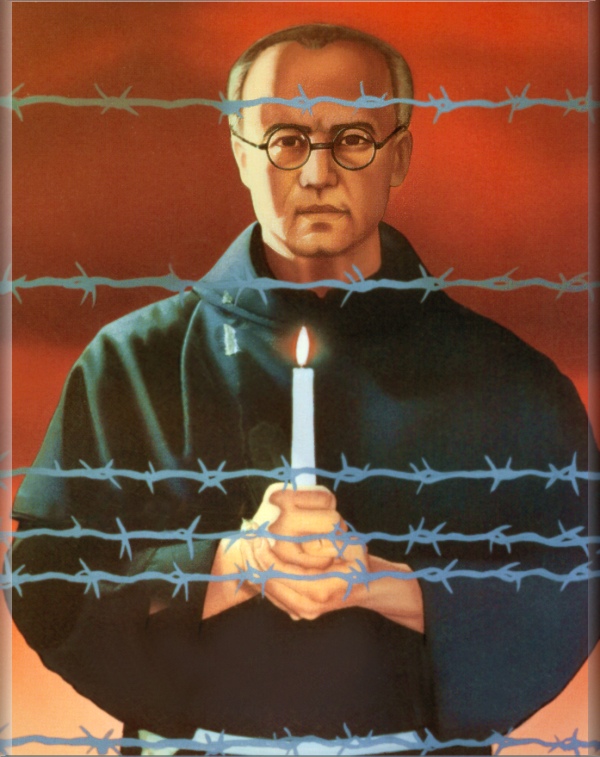
I Volunteer as Tribute: Saint Maximilian Maria Kolbe

As a Catholic fan of the Hunger Games, I can’t help but wonder if author Suzanne Collins was inspired by Saint Maximilian Kolbe to have Katniss take her sister Prim’s place in the 74th Games.
Well, Suzanne Collins is Roman Catholic…
Anything is possible, I suppose.

This is the story of Saint Maximilian Maria Kolbe!

kolbe

There once was a boy named Raymund, who was born in Zduńska Wola, Poland with his father Julius, his mother Maria and four brothers.  Not long after he was born, Raymund and his family moved to another town called Pabianice.
Raymund was an aimless boy; he went to school, helped out around the house, walked around town, etc.  He didn’t seem to have any particular talents that would make him famous or important by the world’s standards.

Then in 1906, the Virgin Mary appeared to him in an apparition that would change the course of his life forever.

“That night I asked the Mother of God what was to become of me. Then she came to me holding two crowns, one white, the other red. She asked me if I was willing to accept either of these crowns. The white one meant that I should persevere in purity, and the red that I should become a martyr.  I said that I would accept them both.”

Raymund joined the Conventual Franciscan minor seminary with his older brother Francis one year later.
Then in 1910, Raymund Kolbe entered the novitiate with a new name: Maximilian.

Now Maximilian and the Virgin Mary were BFFs.  After all, she saved him from a dull life as a directionless country boy by revealing his purpose in life.   Naturally whenever someone impacts your life in a positive way, you feel a desire to repay them and show your gratitude.
In Maximilian’s case, he felt so much love and respect for the Blessed Mother that he not only added “Maria” to his full name (Maximilian Maria Kolbe), not only did he openly promote the veneration of Mary, but he even started the Militia Immaculata (MI) in her honor.  The purpose of MI is to evangelize to the world and convert hearts by relying on Mary’s intercession.  In fact, to become a member of MI, you have to make a personal act of consecration to Mama Mary.
Yep, that’s the sexist Catholic Church; we’re so misogynistic that we canonized a guy who was inspired by a woman to change his life and then started an organization where members consecrate themselves to that same woman.
Just let that sink in for a moment.

Maximilian’s missionary work took him all over the world; China, Japan, and eventually to India.  For reasons unknown, he couldn’t gather a following in China, but he did get a lot of work done in Japan.  He build a monastery on the outskirts of Nagasaki.
Interesting trivia: The atomic bomb that was dropped on Hiroshima and Nagasaki obliterated everything in its path…except for the monastery that Maximilian had built.  In the midst of death and destruction, the monastery was still standing.
Even when tuberculosis forced him to end his travels and return to Poland, Maximilian remained active by starting a radio station in–(do not ask me how to pronounce this) Niepokalanow.
I’ll bet you Satan got ticked with Maximilian; “you have freaking tuberculosis; how are you still moving?  These Mary-loving types are always the hardest to axe off.”

Then everything changed when the Fire Nation–I mean–the Nazis attacked.  In addition to slaughtering innocent Jews, the Third Reich had a particular hatred of the Catholic Church and anyone associated with her (I say “her” because the Church is the bride of Christ).  Maximilian and four other priests were arrested on Feburary 17th, 1941.  When Maximilian was sent to Auschwitz, he was given another new name: Prisoner #16670.

One of the twisted policies of Auschwitz was that if a prisoner escaped, ten prisoners would pay with their lives.  So when three prisoners fled Auschwitz, ten men were randomly selected to spend their days in an underground bunker, where they would left to die from starvation and dehydration.
One of the chosen was Prisoner #26273, also known as Franciszek Gajowniczek.  In a panic, Franciszek cried out, “My wife!  My children!”  Haunted by the fear of leaving his wife to fend for herself with two fatherless child, he begged for mercy.  The Gestapo officers held their batons, ready to strike him to end his pleading.

A man with glasses and a long white beard stepped up and faced the Gestapo.
“I am a Catholic priest from Poland; I would like to take his place, because he has a wife and children.”
The switch was made and Franciszek was sent back in line to live another day.  Wiping off the sweat from his face, he turned to get a look at his rescuer, Father Maximilian Maria Kolbe.
During his final days, Maximilian kept his fellow prisoners in high spirits with prayer and fasting.  He evangelized to the men, giving them hope by telling them of Jesus and His mother Mary and praying with them.
Two weeks later, the guards entered the bunker to collect the bodies.  They froze when Maximilian Kolbe looked up at them, still alive.
A calm Maximilian lifted his left arm and received a deadly injection of carbolic acid.  His body was cremated on August 15th, the feast day of the Assumption of his beloved friend, Mary.

Saint Maximilian Maria Kolbe, pray for us.

How Do You Solve a Problem like Cecilia?: Saint Cecilia

This Saints post exists because I owe Saint Cecilia a favor.  First, here’s some backstory:
Last weekend, I was on a LifeTeen retreat (not as a teen, of course.  I’m a Core member).  On Friday my throat felt scratchy and by “lights out” time, my voice was heading down the drain.  All day Saturday, I had a raspy, chain-smoker voice and it hurt to talk.  As luck would have it, I had to give a teaching on authentic prayer.  Normally Saint Blaise is an obvious person to go to for throat trouble because that’s his patronage, but then Saint Cecilia, patroness of music, came to mind.  I said, “Okay, Cecilia, if you can help me deliver my talk in the exact way that I had practiced it, I will bump you up in my posting schedule and you will be the next CGB Saints post.”

I delivered my talk without forgetting a single word.  Remember when I said that it hurt to talk?  As I gave my teaching, my throat felt just fine.

The hills are alive with the sound of Cecilia!

Saint Cecilia has the typical 2nd century A.D. Roman girl backstory; she was born into a wealthy family.  They were all Christians, but she had been betrothed to Valerian, a Pagan man who had a brother named Tibertius, who will be important later, so remember him.  Anyway, between this and my Saint Lucy post, you have figured out by now that in those days, love was not a central ingredient to marriage.  It takes two prominent families to get their younglings to tango.

Of course, Cecilia had promised God that she would be His bride, consecrating her virginity to Him alone.  Instead of adorning herself in the fine dresses and jewels that her family could afford, a sackcloth was her clothing of choice.
Cecilia and Valerian were married and so began the wedding night.  I’m just gonna paraphrase how I think their conversation went:

CECILIA: Honey, I know I’m your wife now and I have to fulfill my duty to you, BUT…I consecrated my virginity to God and because of that, my guardian angel will be standing guard to protect my purity.
VALERIAN: Uh…all right, prove it.  I want to see the angel.
CECILIA: Tell you what; you go visit Pope Urban and get yourself baptized.  When you get back, you will see my angel.
VALERIAN: Well, it is fashionable to see the Holy Father and such a visit could benefit our families, so why not?

I came so close to referring “the angel of music” from Phantom of the Opera as I was typing this.

Valerian visited Pope Urban and was baptized.  When he returned, his jaw hit the floor.  A magnificent angel was standing alongside his new wife while she played the piano.
I’m just gonna go ahead and sing this: “Then I saw her face.  Now I’m a believer!  Without a trace or doubt in my mind…I’m a believer, I couldn’t leave her if I tried!”
The angel had two crowns, one for Cecilia and the other for Valerian.  The crowns were placed on the heads of husband and wife.

Earlier I told you to remember Valerian’s brother Tibertius.  That’s because Tibertius also became a believer once he saw the crowns on Cecilia and Valerian’s heads.  Two is plenty, but three’s a crowd.

Now in their day, Christians were being martyred left and right.  The prefect of their city had a serious case of bloodlust; not only were Christians were being killed off faster than a Game of Thrones character, but their bodies were left on the streets as a warning to Roman citizens.  Valerian and Tibertius were persuaded by Cecilia to bury the martyrs.  When onlookers would approach them, the brothers would direct them to Valerian’s home, where Cecilia would tell them about Jesus Christ.  A woman in love with Jesus, her eloquence and compassion for nonbelievers brought visitors to their knees as they converted to Christianity.

There is no exact timeline of when shiz went down, but we do know that the prefect of the city put a stop to Valerian and Tibertius’ martyr-burial operation.  The brothers were captured, brought before the prefect, and joined the dead.

Preparing her home to be a church, Cecilia turned around when she heard the door open, thinking it was her husband and brother-in-law.  Her smile left her face when Roman soldiers stood at her door.  She took a breath, entrusting her fate to God.

Standing before the prefect as Valerian and Tibertius had, Cecilia was ordered to be executed by suffocation in the bathhouse.  Thrown into the bathhouse, she was locked inside and the flames arose, whipping at her skin and hair.  The guards waited for the agonizing screams of the woman caged in the inferno.
They didn’t hear a peep from her.
Then the fires were cooled, the doors unlocked and reopened; Cecilia stood very much alive.

His mind blown from this incident, the prefect ordered her to be beheaded.  The executioner approached her, armed with a sword that promised to impale flesh and bone.
The first strike hit her neck, but was ineffective.
The second strike cut through skin and nothing else.
The third strike caught the jugular, but her vocal cords remained.
He ran away after the third blow.

Mortally wounded, Cecilia was left to die in a cell.  She was in dire pain, but continued to preach the Gospel as blood flowed down from her maimed neck, soaked up by the sponges and cloths of those who came to hear her speak.  She used her final breath to share the Good News.

Saint Cecilia, pray for us.

The Silent Carpenter: Saint Joseph (Father’s Day Special!)

If I ever get married and have a son, expect the name “Joseph” to be somewhere in his name (it’ll most likely be his middle name).  I really love the name Joseph, and I also love the most famous bearer of this name.  I’m talking about Saint Joseph, husband of the Virgin Mary and Jesus’ foster father.

Guido_Reni_-_Saint_Joseph_and_the_Christ_Child_-_Google_Art_Project
An epic picture of a sturdy carpenter and gentle father.

Doing research on Saint Joseph the Carpenter is really difficult because the information on him is minimal (there was no such thing as a “digital footprint” in his day).  We do know that he was a carpenter in Nazareth.  His reputation among the locals was that he was a just man.  Humble and mild-mannered, he did his woodwork to make ends meet, got along with everybody, and then went home at the end of the day.

His quiet life changed when he asked for the hand of Ann and Joachim’s daughter, Mary.  His reputation as a gentleman and hard worker sat well with Ann and Joachim.  As for Mary, she knew of Joseph and was drawn to his genuine nature. Like Prince Kit in Cinderella (2015), Joseph wanted to marry for love, not for riches or personal gain.  Hence they were betrothed.

Joseph’s simple life was shaken when his now-fiancee Mary told him that the Archangel Gabriel had visited her and told her she would bear the Son of God (do I even need to say who it is?)  Naturally Joseph was troubled and even upset.  Let’s be honest: Even the most religious person would have a hard time believing that a woman conceived a child without having sex.

Now in their time, to be pregnant and unmarried (being engaged didn’t help) was a death sentence.  The entire village could corner her and stone her, killing both her and the unborn baby.  Joseph knew this and sought to divorce her quietly.  That was, until an angel appeared to him in a dream and told him to take Mary as his wife.  Upon waking up, Joseph knew what he had been called to do.

To protect Mary, they married quickly so that everyone would assume the child was his.  They traveled to Bethlehem, where Mary gave birth to Jesus.  That same night, an angel appeared to Joseph in a dream, and [paraphrasing] said, “You need to get Mary and the baby out of here.”  Sure enough, King Herod had ordered that every male infant be slaughtered so that he would not be overthrown by “the New King.”  This is called the Slaughtering of the Innocents.  Without hesitation, Joseph woke Mary and got his family out of Bethelem to safer regions.

You may have noticed that Joseph has no lines in this play.  That’s because he doesn’t talk in the Bible.  His character is revealed through his actions; his choice to protect Mary from social persecution, his willingness to obey God’s command to leave Bethelem just hours after Mary gave birth, and his devotion to his wife and child.  Saint Joseph is the epitomy of the phrase, “actions speak louder than words.”

Saint Joseph, pray for us.

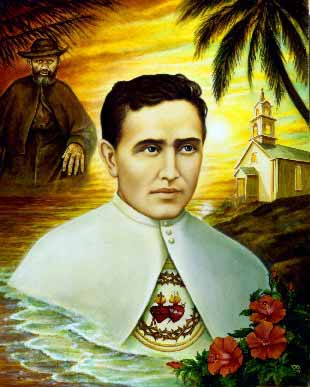
Champion of the Lepers: Saint Damien of Molokai

damien

So in the 1800’s, Hawaii had a bigger crisis on its hands than being the backdrop of a terrible movie (Aloha); it was facing an outbreak of Hansen’s disease, also known as leprosy.  Once you got leprosy, you were a goner.   However our story begins in Tremelo, Belgium, with the birth of a little boy named Joseph de Veuster on January 3rd, 1840.  All that is known about his childhood is that he had to quit school when he was thirteen-years old so that he could work on the family farm.   However, he was able to go to college in Braine-le-Comte, and later entered the Congregation of the Sacred Hearts of Jesus and Mary at the age of eighteen.   In many respects, no one was really surprised.  Both of his sisters, Eugenie and Pauline, were nuns.   His brother Auguste became Father Pamphile.  For Joseph, religious life was in his genes.  On October 7, 1860, he received the name Brother Damien.  At first his superiors thought an uneducated farmer boy was unqualified, but then they learned that his brother had taught him Latin. Yeah…talk about an awkward moment.  #jokesonyoumybrothertaughtmelatin
Damien felt a strong calling to be missionary and prayed for an opportunity to answer that call.  Then his brother got sick and couldn’t go on his assigned mission to Hawaii, so Damien basically volunteered as tribute and took his place.  He hit the road to Honolulu in 1864.  He was ordained into the priesthood two years into his stay.

Imagine moving into a new neighborhood only to find that neighborhood in chaos. That was Damien’s arrival to Hawaii was like; a colony in disarray ruled by a ruthless disease.  The island of Molokai was the leper drop-off station; when you got leprosy, you were shipped off to Molokai.  Damien wouldn’t get to Molokai until nine years later.  He had been working on missionary assignments throughout Hawaii and reached Molokai in 1873.  He was part of a team of four other chaplains, but was the only one of the group who chose to stay permanently in Molokai.  Every missionary assignment had led up to this, and he knew this was the place God had called him to.

Damien became a champion of the segregated lepers.  He advocated government assistance on their behalf.  He said last rites to the dying, baptized infants whether they had contracted leprosy or not, and was responsible for the construction of hospitals, clinics and churches throughout the leper colony.  The children could go to school, and those who had lost their parents to leprosy had an orphanage for refuge.  All of this because of Damien’s efforts and advocacy.  To put it simply, the man got things done.

One day in 1885, he had stepped into some water and noticed that he couldn’t feel the water against his skin.  That is one of the signs of leprosy.  His time was drawing near.  Nevertheless he spent his final days serving the lepers and giving them a better life until his body could take no more.  Damien died on April 15, 1889.

The core of Damien’s character was mission.  He was born with a sense of duty and became a man on a mission to be the face of Jesus to the outcasts.

Saint Damien of Molokai, pray for us.

saint-damien-of-molokai