Christian Movie Reviews: Grace Unplugged

Hey Christian filmmakers, if you want to save the genre, this is the movie you need to imitate.

This is my review of Grace Unplugged! Grace-Unplugged

Grace Unplugged is a family drama that centers around Grace Trey and her father Johnny Trey, a former rock star turned music minister.  The opening scene tells you (very subtly) that though they play in the church band together, there is tension between musical talent Johnny and the equally talented Grace.  When Johnny’s old manager Mostin tries to get him back into the secular music world, Johnny politely declines, but Grace goes behind her father’s back by sending Mostin a demo of her singing.  She enters the world of secular music and is given a new identity as Gracie Trey.  However her inability to write her own songs and the rift she has caused within her family hinders her path to stardom. Aj Michalka gives an impressive and sincere performance as Grace.  Though at times she tends to rely on the “deer-in-a-headlights” look in the second act, her facial expressions convey the protagonist’s inner turmoil.   Aj Michalka portrays a frustrated girl who expresses herself through music and just wants to be free to create.   James Denton plays Johnny Trey, and he gets the most transformation as a character.  I hated him in the first half because of how uptight and overbearing he was, but his journey into humility made him more sympathetic until I finally gave in and changed my mind about him.  This movie succeeds at having both Grace and her father learn a lesson; Grace learns not to throw herself into a world that she’s not ready for, and Johnny sees the error of his suffocating Grace’s talent. The film does a great job at not letting the message clash with the story.  The humanistic script allows the characters to be living, breathing people and not become Bible-belt stereotypes.  The God-dialogue sounds like it’s coming from the characters and not part of an agenda.  The filmmakers understand that our God is not a forceful God, so they avoid forcing His role in the story.  By allowing God to be in control without shoving Him into clumsy dialogue, the moral that God is in control is able to flourish in a natural progression. People, this is a freaking good Christian movie.  It’s a believable family drama, a well-thought character study of Grace and Johnny, and the music is pretty awesome.   I’m gonna go ahead and say it: Grace Unplugged and Soul Surfer are the movies that are going to save the Christian movie genre if filmmakers follow their example.   There is hope for this genre, and it’s movies like Grace Unplugged that are going to lead the way.

Saint Cecilia, pray for us.

The Silent Carpenter: Saint Joseph (Father’s Day Special!)

If I ever get married and have a son, expect the name “Joseph” to be somewhere in his name (it’ll most likely be his middle name).  I really love the name Joseph, and I also love the most famous bearer of this name.  I’m talking about Saint Joseph, husband of the Virgin Mary and Jesus’ foster father.

Guido_Reni_-_Saint_Joseph_and_the_Christ_Child_-_Google_Art_Project
An epic picture of a sturdy carpenter and gentle father.

Doing research on Saint Joseph the Carpenter is really difficult because the information on him is minimal (there was no such thing as a “digital footprint” in his day).  We do know that he was a carpenter in Nazareth.  His reputation among the locals was that he was a just man.  Humble and mild-mannered, he did his woodwork to make ends meet, got along with everybody, and then went home at the end of the day.

His quiet life changed when he asked for the hand of Ann and Joachim’s daughter, Mary.  His reputation as a gentleman and hard worker sat well with Ann and Joachim.  As for Mary, she knew of Joseph and was drawn to his genuine nature. Like Prince Kit in Cinderella (2015), Joseph wanted to marry for love, not for riches or personal gain.  Hence they were betrothed.

Joseph’s simple life was shaken when his now-fiancee Mary told him that the Archangel Gabriel had visited her and told her she would bear the Son of God (do I even need to say who it is?)  Naturally Joseph was troubled and even upset.  Let’s be honest: Even the most religious person would have a hard time believing that a woman conceived a child without having sex.

Now in their time, to be pregnant and unmarried (being engaged didn’t help) was a death sentence.  The entire village could corner her and stone her, killing both her and the unborn baby.  Joseph knew this and sought to divorce her quietly.  That was, until an angel appeared to him in a dream and told him to take Mary as his wife.  Upon waking up, Joseph knew what he had been called to do.

To protect Mary, they married quickly so that everyone would assume the child was his.  They traveled to Bethlehem, where Mary gave birth to Jesus.  That same night, an angel appeared to Joseph in a dream, and [paraphrasing] said, “You need to get Mary and the baby out of here.”  Sure enough, King Herod had ordered that every male infant be slaughtered so that he would not be overthrown by “the New King.”  This is called the Slaughtering of the Innocents.  Without hesitation, Joseph woke Mary and got his family out of Bethelem to safer regions.

You may have noticed that Joseph has no lines in this play.  That’s because he doesn’t talk in the Bible.  His character is revealed through his actions; his choice to protect Mary from social persecution, his willingness to obey God’s command to leave Bethelem just hours after Mary gave birth, and his devotion to his wife and child.  Saint Joseph is the epitomy of the phrase, “actions speak louder than words.”

Saint Joseph, pray for us.

Heaven’s Eye Doctor: Saint Lucy of Syracuse

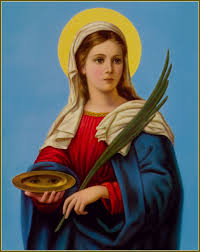
When I started Catholic Girl Bloggin’, I chose my six favorite Saints to be patrons of the blog.  One of those patrons is Saint Lucy of Syracuse.  She came into my life when I was a senior in high school, and she has been my spiritual sister ever since. Lucy is the patroness of eye issues.  She healed my mother when she had pink eye a few years ago.  Last year, when I had a case of dry eyes, I prayed to Saint Lucy and in three days my eyes were healed.

download

Saint Lucy was born in Syracuse, Sicily.  She entered the world when the Roman Empire was in some serious shiz.  Heads were rolling, and I do mean that literally because Christians were being executed left and right.  Her father died when she was five, so her mother Eutychia raised her alone.  Lucy embraced her mother’s Christianity and at a young age made a promise to Jesus that she would consecrate her virginity to Him.  In other words, she would never marry and instead be a single bride of Christ for the rest of her life.   However in her day, unmarried women were either left begging on the streets or taken captive by enemies of the Roman Empire.  Out of fear for Lucy’s future, Eutychia did the only thing she could do: She arranged for Lucy to be married off to a young man from a wealthy Pagan family.

The turning point in Lucy’s life came when Eutychia learned she had a blood disorder.  Lucy was able to convince her mother to make a pilgrimage to Catania, where the main attraction was the tomb of Saint Agatha (patron saint of those who suffer from breast cancer).  As Lucy prayed at the tomb, Saint Agatha appeared to her in a vision.  I’m just going to paraphrase how their conversation went:

AGATHA: Lucy, your mother will be cured, but you will be called to martyrdom.

LUCY: Just cure my mother, and I will do whatever He asks of me.

As Agatha promised, Eutychia was cured and after some persuasion from Lucy, she allowed her daughter to serve the poor and the family wealth was used to help those in need.  As time went on, Lucy made a name for herself with her charitable works to the less fortunate, and later, her aid to Christians who were hiding in the catacombs.  She would carry food and drinks to them, unaware of informants who sought to betray the persecuted Christians.

Now Lucy was known to have been very beautiful.  She had striking eyes that sparkled with the light of Christ within her.  I mention this because her former fiancee, the young man from the wealthy Pagan family, wanted her as his wife. But remember, she had made a vow of perpetual virginity to Jesus, so that wasn’t going to work.  Also after her mother was cured, the betrothal had been called off. So the angry ex-fiancee went to Governor Pascasio.  As a result, Lucy was caught and became a prisoner of the Empire.  Her martyrdom took place in Syracuse’s magnificent amphitheater, where Pascasio sat along with politicians and general.  It was Lucy vs. All of Rome.

I used to think of Lucy as a sweet, docile Saint.

I was wrong.

When she refused to worship the Pagan gods, Pascasio ordered that she be forced into prostitution.  The Roman guards gathered to take her to the brothel, but to their surprise, her body was suddenly immovable.  No, seriously, she was like a statue.  More guards came to try and move her.  Even a team of oxen was used to try and haul her, but the thin girl was now heavy as a boulder.  By the power of Christ she was protected from the house of sexual sin.  Pascasio’s next move was to have her burned at the stake.  As she stood in a bundle of twigs, soldiers began to ignite the twigs, but they wouldn’t burn.  Even when they were soaked with oil, no fire would come.  As you can imagine, Pascasio was not happy being one-upped by a young Christian girl.  In desperation, he ordered that her eyes be gouged out, which is why she is the patron saint of eye problems.  As blood ran down her face from where her sparkling eyes used to be, Lucy did not scream or cry.  She simply stood there, professing faith in Jesus Christ.  It is said that her bravery and the miracles surrounding her inspired many Pagans to convert to Christianity.  Lucy was then stabbed in the neck by a soldier.  She had won the battle and went to Heaven as a victor on December 13th, 304 A.D.

Champion of the Lepers: Saint Damien of Molokai

damien

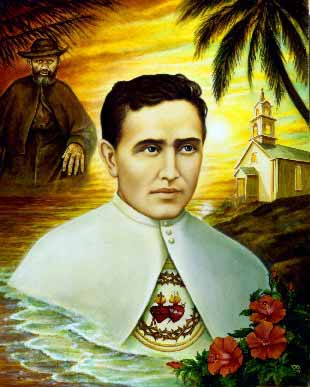
So in the 1800’s, Hawaii had a bigger crisis on its hands than being the backdrop of a terrible movie (Aloha); it was facing an outbreak of Hansen’s disease, also known as leprosy.  Once you got leprosy, you were a goner.   However our story begins in Tremelo, Belgium, with the birth of a little boy named Joseph de Veuster on January 3rd, 1840.  All that is known about his childhood is that he had to quit school when he was thirteen-years old so that he could work on the family farm.   However, he was able to go to college in Braine-le-Comte, and later entered the Congregation of the Sacred Hearts of Jesus and Mary at the age of eighteen.   In many respects, no one was really surprised.  Both of his sisters, Eugenie and Pauline, were nuns.   His brother Auguste became Father Pamphile.  For Joseph, religious life was in his genes.  On October 7, 1860, he received the name Brother Damien.  At first his superiors thought an uneducated farmer boy was unqualified, but then they learned that his brother had taught him Latin. Yeah…talk about an awkward moment.  #jokesonyoumybrothertaughtmelatin
Damien felt a strong calling to be missionary and prayed for an opportunity to answer that call.  Then his brother got sick and couldn’t go on his assigned mission to Hawaii, so Damien basically volunteered as tribute and took his place.  He hit the road to Honolulu in 1864.  He was ordained into the priesthood two years into his stay.

Imagine moving into a new neighborhood only to find that neighborhood in chaos. That was Damien’s arrival to Hawaii was like; a colony in disarray ruled by a ruthless disease.  The island of Molokai was the leper drop-off station; when you got leprosy, you were shipped off to Molokai.  Damien wouldn’t get to Molokai until nine years later.  He had been working on missionary assignments throughout Hawaii and reached Molokai in 1873.  He was part of a team of four other chaplains, but was the only one of the group who chose to stay permanently in Molokai.  Every missionary assignment had led up to this, and he knew this was the place God had called him to.

Damien became a champion of the segregated lepers.  He advocated government assistance on their behalf.  He said last rites to the dying, baptized infants whether they had contracted leprosy or not, and was responsible for the construction of hospitals, clinics and churches throughout the leper colony.  The children could go to school, and those who had lost their parents to leprosy had an orphanage for refuge.  All of this because of Damien’s efforts and advocacy.  To put it simply, the man got things done.

One day in 1885, he had stepped into some water and noticed that he couldn’t feel the water against his skin.  That is one of the signs of leprosy.  His time was drawing near.  Nevertheless he spent his final days serving the lepers and giving them a better life until his body could take no more.  Damien died on April 15, 1889.

The core of Damien’s character was mission.  He was born with a sense of duty and became a man on a mission to be the face of Jesus to the outcasts.

Saint Damien of Molokai, pray for us.

saint-damien-of-molokai