CGB Review of The Imitation Game

Within minutes after I pressed play on the DVD menu, the film opens with an assertive narration from Alan Turing:
“Are you paying attention?  Good.  If you are not listening carefully, you will miss things. Important things.  I will not pause, I will not repeat myself, and you will not interrupt me.  You think that because you’re sitting where you are, and I am sitting where I am, that you are in control of what is about to happen.  You’re mistaken.  I am in control, because I know things that you do not know.”
Mr. Turing, I’m all ears.

This is my review of The Imitation Game!

Benedict-Cumberbatch-the-imitation-game

The Imitation Game is the true story of Alan Turing, a mathematician, cryptanalyst and eventual war hero who broke the unbreakable war codes of Nazi Germany’s Enigma machine.
So this was the highest grossing independent film of 2014 and frankly, all of that money is well deserved because this is an excellent film.  I have nothing bad to say about this movie, so here is everything right with the Imitation Game!

I want that soundtrack!  The musical score is haunting and hypnotic.  Heck, I can still hear it in my head hours after the credits roll.  In fact, I’m listening to it on YouTube as I write out this review (it’s playing on my tablet).  It’s the kind of music that I would want to listen to while walking at the park or jogging around my neighborhood.
Like Bradley Cooper in American Sniper, Benedict Cumberbatch is mesmerizing as Alan Turing.  This is a man who is lost in his own head, expressing himself through codes and calculations.  An antisocial and off-putting man who is never intentionally hurtful, machines and mathematics are his true love, making more sense to him than the emotional responses of others.  His ideas are so complex that not even people who are as smart as him have any clue as to what he’s talking about.  This prevents the clichéd “he’s a misunderstood dreamer and everyone else is a jerk who doesn’t get him” trope.  Benedict Cumberbatch’s thoughtful performance portrays Alan Turing as someone I would want as a teacher or a mentor.
Keira Knightly is wonderful as Joan Clarke, who shares a chaste, emotional connection with him.   Alan and Joan never touch in a sexual way, yet their souls speak to each other through their intellect.  Their last scene together is heartbreaking as we see these two bright people allow themselves to be vulnerable and emotionally-naked with each other.
Ever since I reviewed Right to Believe, I always pay close attention to the portrayal of a homosexual character; is it sensationalized or handled with tact and grace?  Does it define the character or is it only an aspect of a three-dimensional protagonist?  Is the LGBT character written as a human being or an agenda pawn?  By this litmus test, the Imitation Game passes the class with flying colors.  His homosexuality is a subplot and never consumes the story.  In fact, for a while, I thought Alan Turing was asexual (someone who does not experience sexual attraction; different from celibacy.  http://www.asexuality.org/home/?q=overview.html )  I like how the subject of homosexual men marrying women is treated as the complex matter that it is; neither Alan nor his fiancée Joan is vilified.  He deeply cares for her, but feels conflicted; she genuinely loves him as her closest friend, but societal norms mandate her to be married.
Overall the film gives us a sense of what it’s like to be Alan Turing; the script is so intimate with the main character that it’s like the director and/or screenwriter personally knew Turing.  Like Amelie and American Sniper, the Imitation Game knows its protagonist and wants you to know him, as well.  This is a humanistic film that tells the story of a brilliant man who was forced to hide his sexuality from the very world he was trying to save.

SPOILER CORNER!!!!  IF YOU HAVE NOT SEEN THE IMITATION GAME YET, SKIP THIS SEGMENT!!!
The ending got to me.  I was disgusted at the way the British government treated him after he was arrested for gross indecency, for just being a homosexual.  He was given two options: Two years in prison or chemical castration.  He chose castration so that he could continue working.
I mentioned Alan and Joan’s last scene together, which comes at the end before the text comes on-screen revealing Alan’s suicide.  I bring it up because this is the scene that moved me the most.  Alan tells Joan that he continues the government’s hormonal treatment so that he can keep Christopher, the machine that broke Nazi Germany’s Enigma.  “If I don’t continue, they’ll take Christopher away from me and I’ll be alone,” he bursts into tears, “…and I don’t want to be alone.”  Joan comforts him and suggests he do a crossword puzzle, his favorite hobby.  When he struggles to lift the pencil and says, “I’ll do it later,” that’s when I knew it was over for him.
Once the end text reveals that he killed himself at the age of 41, I started crying.  To be driven to such despair is always a tragedy, but to do the courageous act of defeating Nazi Germany’s war machine and then be repaid with cruelty is equally tragic.

Saint Edith Stein/Teresa Benedicta of the Cross, pray for us.

Let’s Talk about Chastity!

I was thirteen when I was given my chastity ring and made a promise to God that I would save myself for marriage.  Now that I think about it, making this promise wasn’t hard at all because as a teenager, I was never interested in sexuality.  I was that girl who would write a short story during Sex Ed instead of taking notes on human anatomy.  A book about Helen Keller was more interesting to me than a magazine with scantily-clad models.
I misplaced my chastity ring during my first year of college.  I couldn’t find it until the night before I broke up with my first boyfriend, who couldn’t handle my “no-sex-till-marriage” rule.  The tiny golden ring shimmered at the bottom of my jewelry box.
It was on my finger when I told him that we were done.
I’ve worn it every day ever since.

After ending a relationship that had posed a threat to my promise to God, I decided to investigate the true meaning of chastity.  “I should be good to go.  I always dress modestly, I never watch steamy movies, so I’m fine,” I thought.  Mind you, this was before I became a movie-reviewing blogger, which requires me to watch movies with some steamy content, but that’s another story for another day.   Reading the segment on chastity in the Catechism (talk about “light reading,” huh?) was a major eye-opener for me.  I learned that chastity is so much more than just dressing modestly and not watching movies that contain sex scenes.

Chastity is the successful integration of sexuality into the individual’s innermost being.  In other words, the natural sexual urges and desires are something that you control and not the other way around.
The Catechism points out that, “Chastity is an apprenticeship in self-mastery, which is training in human freedom.  The alternative is clear: either man governs his passions and finds peace, or he lets himself be dominated by them and becomes unhappy.” (CCC 2339, pg. 562).
Here’s an example: A wife is too tired for intimacy and just wants to go to bed. Now while the husband may want to be intimate with her, the self-mastery brought on by chastity allows him to control his urges and respect his wife’s wishes.
Some argue that chastity contrasts with human freedom, but part of being a free person is being free within yourself.  For instance, no one is free from becoming angry, but if you let that anger overpower you and cause you to scream at a loved one or start throwing things, then you’re not really free within yourself.
No one is free from sexual desire.  Sexuality is a gift from God that is a part of our biology.  What you do with those natural desires is where self-mastery or lack thereof comes into play.
Now there are those who argue that chastity falls in line with sexual repression.  To that, I say not necessarily.  Chastity doesn’t call for an all-out embargo on desire, but rather a mastery over them.  You acknowledge that they are present, but you don’t let them rule your life.  You give yourself the freedom to choose whether to control your hormones or let your hormones dictate you.
Self-mastery in chastity is like self-mastery in every other arena of your life.  The self-mastery to stop eating when you’re full instead of gorging yourself, the self-mastery to have one or two drinks instead of getting ridiculously drunk, the self-mastery to get yourself up for your 6 am job instead of sleeping in and being late for work.
Is chastity a difficult proposition?  Yes, especially in our culture, which has a stalker’s obsession with sex.  However just because something is difficult doesn’t make it impossible.
The world defines the body as a tool for lust; Chastity says the body is a temple.  Chastity allows us to see each other not as objects for pleasure, but as the unique, multifaceted human beings that God created us to be.

CGB Review of Jupiter Ascending (2015)

I once wrote a story about a girl who enters another world and finds out that she is the Destined One, the only person who can save two worlds.  Along the way she meets characters whose dialogue consisted of backstory and exposition about the world.

I wrote this story when I was twelve-years old.

This is my review of Jupiter Ascending!

Jupiter-Ascending

Jupiter Ascending tells the story of–well, to be honest–many things, but here’s the main plot: A young woman named Jupiter lives as a janitor with her family of Russian immigrants.  After surviving an assassination attempt on her life at a fertility clinic, she is rescued by Caine, a…(trying to keep a straight face) half-man, half-wolf splice hybrid person who tells her that she is the Queen of the Earth and must reclaim her throne from the Abrasax siblings named Balem, Titus and Kalique.  Along the way, Jupiter encounters other characters who are more interested in spouting out exposition and complicated backstory about their world than in being interesting characters with distinct personalities.

Do you have any idea how hard it was for me not to burst out laughing while typing the movie’s summary?  I only saw this movie once and I walked out of the theater after the first hour.
Have you ever seen a movie where it’s painfully obvious that key scenes are missing and the director(s) have no idea how to properly pace a story so that it flows smoothly?
Yeah, that’s basically Jupiter Ascending in a nutshell.
I took a lot of creative writing classes in high school and later in college.  In creative writing, one thing you learn that is there’s no right way to tell a story, but there are many wrong ways to do so.  Hence the best way to review Jupiter Ascending is by going over the “what-not-to-do’s” of storytelling and then explain how Jupiter Ascending breaks those guidelines.

1. Don’t let any backstory overshadow the current plot.  Jupiter Ascending puts less detail in basic character development and instead relies heavily on the needlessly convoluted history of its world.  As a result, all the exposition becomes a distraction from the movie’s central plot.

2. Create characters, not exposition-explaining pawns.  EVERY CHARACTER does nothing but monologue about how this worlds works.   Jupiter herself is just what I call a “window character,” someone who only exists as a stand-in for the audience as we learn about the film’s universe.  Window characters are fine as long as they have their own identity other than just being an observer.

3. Don’t introduce any ideas that you don’t plan on following up on. The main antagonist Balem (played by Eddie Redmayne) says, “I will harvest that planet tomorrow [Earth] before I let her [Jupiter] take it from me.” In other words, he’s going after Earth in 24 hours…and then that threat is never mentioned again. Actually Balem kind of disappears from the plot for a while.

4. Don’t drop any important characters. If you have a large cast of characters, make sure you can account for each of them.  All of the characters get rushed introductions and their personalities are so bland that it’s hard to care about any of them or what they’re going through.  As mentioned in #3, the main antagonist Balem is a major player for about 20 minutes, and then just disappears for a while because….unicorns!  The titular character Jupiter (played by Mila Kunas) is basically a damsel in distress and when she does start to develop as a character, it comes off as rushed and out-of-left-field.

If you take away anything from this review, let it be this: Please don’t name your character “Jupiter Jones.”
Just don’t.

CGB Review of Oz The Great and Powerful (2013)

Hello James Franco!  I see you’re back for a second appearance on CGB (see my review for The Interview).
I wish I could say “nice to see you again,” but…(sigh)…

This is my review of Oz the Great and Powerful!

oz_the_great_and_powerful_3d_movie-wide

Oz the Great and Powerful is a prequel to the classic Wizard of Oz.  It tells the story of a shady, self-serving con artist named Oscar Diggs who ends up in a magical land and is mistaken to be the prophesized wizard who will save everyone from the Wicked Witch.

I grew up reading classic fairy tales as a kid and I’m a fan of the live-action fairy tale genre.  I adore last year’s Maleficent and Cinderella is on my list of best 2015 movies.  I even enjoyed the admittedly-flawed Into the Woods from last year.
As a fan of the genre, Oz the Great and Powerful is a disappointing watch.

The Hits
James Franco is not the problem here or in The Interview.  In fact, he’s a pretty good actor.  He does a decent job portraying a selfish, superficial man with guile and hidden agendas.  I also like that he starts out oblivious to how his self-absorption hurts others and how he slowly changes his ways once he realizes the consequences of his lies and half-heartedness.   That’s a good message for kids (this is a kids movies, after all).  It’s also good for kids to see that you don’t have to be a perfect person to do great things.  The only developed character is James Franco’s Oz, so his performance alone is what kept me watching.
I don’t have a lot to say about Mila Kunas, Rachel Weisz and Michelle Williams, but I will give them credit for doing what they could with their roles.  Even though I think Mila Kunas is better in films that take place in modern-day settings than in period pieces or fairy tales, but she is actually believable as the naïve, hot-headed Theodora.

The Misses/The Problem with Prophesy Stories
Making this a chosen-one story was a big mistake.  Any time a character is predestined to go on a quest, all the authenticity and character agency is lost.  No matter how hesitant the character is, you know that he/she is gonna end up choosing to go along with the prophesy anyway, so their choice to do so comes off as a demand of the script.  Because Oz is the important person who is prophesized to save the land, none of the friendships he has with the side character feel genuine.  It has the vibe of “we’re your allies because you’re the destined one” and not “we’re your allies because we sincerely care about you as a person.”  Personally I find it more compelling when characters choose to go through Hell and back for each other even if they have nothing to gain from being with one another.  In addition, the relationships are never fully developed enough to be considered authentic because the script is a by-the-numbers checklist of prophesy clichés.
Also this should’ve been an animated film.  The environments would have looked much better than they do here.  There’s one sequence where the camera zooms in on a swarm of butterflies and it looks weirdly pixelated.  This only bugs me because none of the other effects are pixelated.  The CGI looks gorgeous when the camera is still, but a pan-across shot shows how incredibly fake the CGI is.

Overall Oz the Great and Powerful made me sad.  The actors all do a capable job and the colors are stunning, but there’s nothing enchanting about contrived relationships and predictable story formulas.

CGB Review of Gone Girl (2014)

There is a major spoiler about one of the characters in this review, so SPOILER AHEAD.

This is my review of Gone Girl!

gonegirlposter

I love Gillian Flynn’s novel “Gone Girl,” which this movie was based on.  I’ve read that book so many times and I’m sure I’ll be reading it again real soon.  Before I ramble on and on about how awesome the book is, let’s talk about the movie.
On the morning of Nick and Amy Dunne’s 5th wedding anniversary, Nick discovers that Amy has disappeared.  From there, a nationwide search for her is launched and Nick must deal with Detective Rhonda Boney and Detective Jim Gilpin, who begin to suspect that he [Nick] murdered his wife [Amy].  While that’s going on, we get to look into Amy’s diary, where the Dunnes’ troubled marriage is chronicled.

As a fan of the book, I am happy to say that this is one of the most faithful book-to-film adaptations that I have seen in a while.

The Hits
David Fincher’s use of a cool color palate, an eerie musical score that sounds like someone is just around the corner, waiting to get you (we have Atticus Ross to thank for that), and smooth camera pans fit this movie like a glove.  In the writing category, I have great respect for Gillian Flynn, who wrote the screenplay for the film.  I’m sure it wasn’t easy deciding which things to cut and which story elements to keep, but I can tell that she put the time and effort to making sure that the film matches her vision as accurately as possible.  There’s an old adage, “If you want something done right, do it yourself.”
Rosamund Pike was born to play Amy Elliott Dunne, the most disturbing femme fatale in recent memory.   This icy Hitchcockian blond with a haunting voice that would make anybody look over their shoulder if they heard her speak is calculating, methodical and armed with 20/20 foresight.  She thinks of everything and spares no one in her path; Satan asks her for advice.  She will ruin you and then reassemble you to fit her vision.  She doesn’t need to point a gun to hurt you; all she has to do is know you.   That is how she begins to destroy you.
Ben Affleck not only understands Nick Dunne, but he even does a better job at representing Nick than the book.  He exceeded all expectation with his portrayal of a lazy, pathetic, country-boy adulterer who avoids any and all conflict, even if it’s staring him right in the face.
Tyler Perry gives a surprisingly stellar performance as the cocky slimeball Tanner Bolt, Carrie Coon is grounded and down-to-earth as Margo “Go” Dunne, and although he seems a bit miscast, Neil Patrick Harris does a good job as the creepy Desi Collings.

A Word of Caution
Are you discerning married life?  Is your own marriage in a rough patch?   Are you unsure or even suspicious of the institution of marriage?  If you answered “yes” to any of these questions, then this movie might get under your skin.  Both the movie and especially the book lean towards an anti-marriage point of view.  In both versions, married characters are either miserable or idiotic, Amy Dunne makes plenty of “don’t-get-married” statements, and the Dunnes’ marriage freefalls from passionate to insufferable.
That all being said, do keep in mind that this is a work of fiction, and Gillian Flynn herself is a married woman.  She even gives her husband a glowing acknowledgment at the end of the book.

Overall Gone Girl is one of the best thrillers in recent years that will quite literally keep you guessing until its gut-wrenching conclusion.

Christian Movie Reviews: Do You Believe?

My Fant4stic Four review was written at 1 o’clock in the morning and despite being very tired, I pushed myself to talk about a movie that couldn’t care less about its own existence.
Now it is 11am, I am well rested and ready to review a risk-taking, gut-wrenching Christian film called Do You Believe?

Do-You-Believe

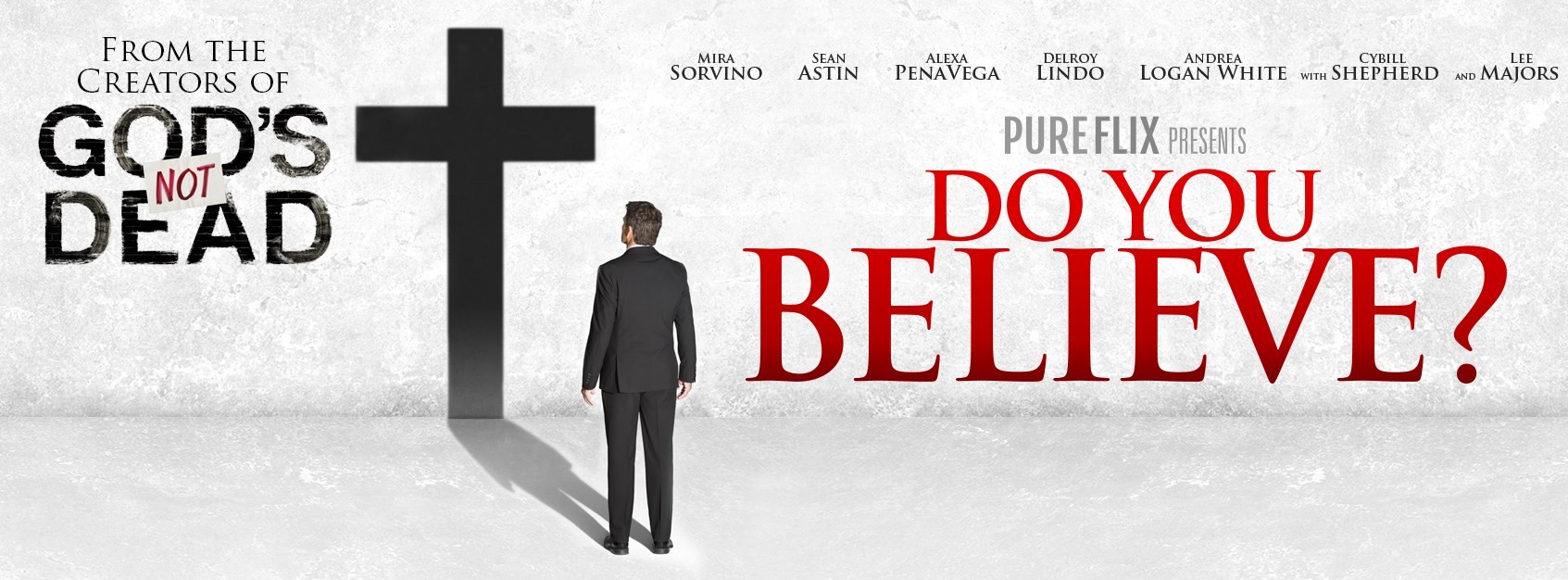
Do You Believe?, which was created by the same people who made God’s Not Dead, tells the story of twelve desperate characters whose lives will inevitably intertwine as they come to see the power of the Cross.
I have no idea why this movie wasn’t a hit like God’s Not Dead because this is another genre-saving movie that Christian filmmakers need to imitate.

How many Christian films do you see take on homelessness, self-mutilation, gang violence, PTSD, familial abandonment, loss of a child, teenage pregnancy and other heavy topics in just two hours?  Now while they never get R-rated graphic with the self-cutting or the gang violence, just having those elements in a Christian film is pretty bold.
All of the performances are excellent with every single actor being fully invested in their roles.  There’s a sense that the director and screenwriters (two people wrote this movie) know that this film isn’t going to appeal to everyone, but they’re willing to take that chance so that they can passionately tell the story that they want to tell.  Quite frankly, I can’t help but admire everyone involved with this project.
I was biting my nails because telling multiple storylines is a difficult formula and it has more failures than successes.  However I am delighted to announce that this is a brilliant multiple-character study.   Each storyline is well-developed and the pacing–hallelujah!–the pacing is smooth sailing.  There is never a dull moment because every scene has a rhyme and reason for existing.   The film transitions very well because each story arch ties into another story arch, woven like a quilt of cinematic competence.
Thank you, Lord Jesus, for a Christian film that FINALLY tackles “faith without works is dead.”  That is shockingly rare in Christian movies, so for a film in this genre to acknowledge that belief in Jesus requires action is a much needed breath of fresh air.

Okay, now I’ve praised the film to death, there are some things I have to address.  Like Amelie, this is a niche film.  Atheists will not like this movie because the non-believing characters range from militant jerks (Sean Astin’s doctor character) to vaguely defined semi-atheists (Andrea Logan-White’s lawyer character).  The agnostic characters are more like sort-of agnostic-ish who just need the kindness of a Christian friend in order to convert.  Also some of the dialogue can get preachy and one of the storylines ends with a miracle that kind of comes out of left field.

I remember one of the teens at my LifeTeen youth group telling me that she saw this film in theaters and was blown away by it.  Having watched it, I can see why.  Passion and talent permeate every frame of this film.  Unlike the people who slogged through Fant4stic Four, everyone put their all into this movie and that’s really all I could ask for.

The movie challenges viewers with the question: “If you believe in the power of the Cross, then the question is…what are you gonna do about it?”
Your move; what’s your answer?

CGB Review of The Fantastic Chore–I mean–Four

Pushing open the double doors, I looked up at the ceiling.  “Dear sweet Virgin Mary, Mother of God, please tell me: What in the wide world of heck did I just sit through?” I asked aloud as I stumbled out of Theater 10, tossing my now-empty soda cup into the trash.
The Blessed Mother didn’t answer, but if she had, she probably would’ve answered in a gentle voice, “A very crummy movie, my dear.”

This is my review of the Fantastic Four!

2015_fantastic_four-1920x1080

The Fantastic Four tells the story of four young adults who are brilliant in the field of science.  Now I’m aware that this movie is based on the…(looks at info sheet)…the Ultimate Fantastic Four comic book, which debuted in 2004.   In previous incarnations of the “First Family of Comics,” as they are called, the Fantastic Four get their powers via space travel.  However in this version, it is inter-dimensional travel that graces them with their supernatural abilities.

So it’s exactly 1:16 am and I’m very tired.  However I’m not going to be like the makers of this corporately-mandated movie and give you a half-baked review; I’m going to use the last of my energy to tell you that this is one of the most passionless movies I have ever seen.  Just like Aloha, Pup, Christian Mingle the Movie, Last Ounce of Courage and Bad Teacher, I have absolutely nothing good to say about Fant4stic Four.
Here is everything wrong with The Fant4stic Four!

What the heck is up with the stiff and wooden line-delivery in this film?  If you were telling someone about a project that you’ve spent years of your life working on, you wouldn’t say it in a flat voice and with no emotion, but that’s exactly what happens in this film.  The biggest offenders are the kid who plays young Reed Richards, Reg. E Cathey (Dr. Franklin Storm), Miles Teller, and Kate Mara.
Okay, I’m going to give Ms. Mara a break because I know that she was verbally abused by director Josh Trank, which could explain her drained and tired performance as Sue Storm.  That being said, an explanation is not an excuse for her detached acting.
Miles Teller, who was the only entertaining part in The Divergent Series: Insurgent, is completely neutered as Reed Richards.  He sounds totally bored every time he speaks.  When he does try to inject some life into his character, it comes off as forced and awkward.
Reg. E Cathey annoyed me.  He’s got a cool gravely voice, but man, he is a drag to listen to.  He does have one good scene with Michael B. Jordan where he actually makes a sincere effort to act, but for the rest of the movie, he is devoid of emotion and is practically sleepwalking his way to a paycheck.
The only actors who are even trying are Michael B. Jordan, Jamie Bell and Toby Kebbell, but even they become victims of the movie’s biggest problems.
Fant4stic Four has a major character development issue.  Personalities of characters will literally switch in a matter of minutes.  Jamie Bell will be the cautious one and Michael B. Jordan is the risk-taker, but then in another scene, Jordan is all, “No way, let’s not do that” and Bell is the one walking into a risky situation.  One minute, Kebbell is looking out for himself and Teller is the moral one, and then in the next minute, Teller is the self-serving opportunist while Kebbell is pulling back.
We’re supposed to believe that Reed, Sue, Ben and Johnny are this family unit who would go through hell and back for each other.  If that’s the case, then this movie does nothing to prove it.  Reed and Ben feel more like acquaintances instead of childhood friends, the “romance” between Reed and Sue is contrived as all heck, Sue being the adoptive daughter of Dr. Franklin Storm is slapped-on and has no presence within the character and her relationship with her half-brother Johnny (Franklin’s biological son) is nonexistent.  Because little thought was put into developing the characters as people, their decisions feel like demands of the script and not organic choices that they would willingly make and their relationship with each other lacks authenticity and heart.
One more thing: Yes, the rumors are true.  The first act is drunk on tolerably bland build-up.  The second/third act of this movie is insufferable and a half-hearted final battle with Dr. Doom is the nail in the coffin.

Overall I tried to keep an open mind with this movie and my brain fell out as a result.  It is now 2 am and I wish you all good night…until my next review.  🙂

“If I speak in human or angelic tongues, but do not have love, I am a resounding gong or a clanging cymbal.”
–1 Corinthians 13:13

Update: Check out this video on the troubled production of this film, which is actually more interesting than the film itself.

CGB Review of The Interview (2014)

Before the climactic interview, Kim Jong-un (Randall Park) gives Dave Skylark (James Franco) the most ADORABLE Cavalier King Charles Spaniel as a gift and Skylark almost caves in to the dictator’s charms.
To be fair, if a crazed dictator handed me a sweet puppy with a melting expression, I’d probably cave, too.
Why do I bring this up?  Because honest to God, I just wanted an excuse to show a picture of the dog from the movie.
53e07b64c90e8c2caa0001fc
You may now commence your “oohs” and “awwws.”

This is my review of The Interview!

In Franco and Rogen we trust.

This is the movie that North Korea had a major freakout about last year.  The Interview tells the story of TV host Dave Skylark and his producer Aaron Rapoport.  Together they run a tabloid show where they cover stories like Rob Lowe being bald or Eminem coming out as gay, etc.  When they learned that North Korean dictator Kim Jong-un is a huge fan of Skylark’s work, the two men set out to interview him.  However things get complicated when the CIA gets involves and wants Skylark and Rapoport to assassinate Kim Jong-un and used the interview as a cover to do so.

Before I start this review, let’s talk about the controversy behind it.
In June of 2014, North Korea flipped out over the premise of this film; two journalists being sent to assassinate Kim Jong-un while using an interview as a cover.  North Korea was so furious that they threatened to take action against the United States if Sony Pictures released the flick.  To prevent a third world war, the film was delayed from its October release to a slot in December and it was re-edited so that North Korea wouldn’t nuke us.  Then the Sony hacking thing happened, and The Interview ended up online and in limited release.

So is this raunchy comedy worth almost getting nuked?
Hmm…sort of.
By the way, I want you to remember that this film was re-edited.  It’ll be important later.

The Hits
The opening scene is hilarious!  Dave Skylark is interviewing Eminem and, literally out of nowhere, Eminem comes out as gay.  The reveal itself lacks the build-up needed for this kind of scene, but what had me laughing was how Eminem keeps a stoic expression on his face the whole time while Dave Skylark overacts.  “I’ve been leaving a gay trail of breadcrumbs,” Eminem says in the most nonchalant way.   The hilarity of the scene stems from the fact that Eminem is robotically calm while everyone else in the studio freaks out.  Characters’ reactions or even lack of reaction can be funny when it’s set up correctly.
James Franco and Seth Rogen’s believable chemistry carries the film.  I like how Seth Rogen is the calm and collected straight-man to James Franco’s whacky egotistical arch.
[A BIT OF A SPOILER] So Franco’s character spends the day with Kim Jong-un, who turns out to be a nerd who likes Katy Perry and margaritas.  I gotta say that I admire the decision to dilute Kim Jong-un’s character.  Even though I have…a variety of issues with portraying a DICTATOR as a hapless puppy-dog of a man, I give credit to anyone who is willing to make a risky move.
Also, extra brownie points for that precious Cavalier King Charles Spaniel!

The Misses
Why did I want you to remember that this film was re-edited?  Because when it shows, it REALLY shows.  It’s not so much in the scene transitions, but in plot points.   For one, they make it clear that James Franco’s character is successful beyond his wildest dreams, so why would he agree so readily and without much of a fight to switch from doing entertainment news to taking on the dangerous task of interviewing a dictator?  The brief argument between Rogen and Franco over taking on the task is so rushed and has no build-up to what’s at stake that it lacks emotional investment.  [ANOTHER SPOILER] When we do find out that Kim Jong-un is batshiz insane, the reveal is so abrupt that even though I knew it was coming, the gravity of the revelation just wasn’t there.  More time was put into making him look innocent than it was on giving the audience a sense of unease about his character.   I have a feeling that when they were re-editing, some key scenes that could have fixed these problems ended up on the chopping block.
Speaking of which, this movie has a major build-up problem.  When the CIA approaches our main protagonists and explains what they [CIA] want them [Franco and Rogen] to do, the weight of the situation is nonexistent because it’s treated too light-heartedly.  Even Horrible Bosses understood how to keep the seriousness of attempting to kill their bosses while remaining a comedy.

Overall I can sort of see why North Korea didn’t want this movie to be released, mainly because of the premise and the portrayal of their ruler.  However The Interview should’ve been written as a dark comedy instead of a slapstick comedy.  That way, it would’ve been a serious situation with comedic reactions instead of a film with a mishandled tone.

CGB Review of Amelie/Le Fabuleux Destin d’Amelie Poulain (2001)

The irony of this review is that a movie about a young woman with short dark hair is being reviewed by a young woman with short dark hair.  (Plays Inception music in the background)
I’d be weirded out if Amelie was also a blogger.

This is my review of Amelie/Le Fabuleux Destin d’Amelie Poulain!

amelie

After having lived through a quirky childhood with her eccentric, neurotic parents, Amelie Poulain grows up to be a shy, self-isolating waitress whose life changes when she stumbles upon a memorabilia that belongs to a man who lived in her apartment in the 1950’s.  After she returns it to him, she makes it her mission to help others by finding their lost stuff and giving it back to them, all while coping with her own inability to form connections with others.

Guys and gals, this is going to be a tough review.  A lot of people really like this movie, or at the very least respect it.  I’m going to review this with as much charity to the fans of Amelie as possible, but at the end of the day, I have to be honest.  This film is definitely an acquired taste and I tried really hard to get sucked into the whacky and whimsical world of Amelie, but I had some issues with it.  As always, though, I’ll start with the positive.

What I Liked
As a character study, Amelie succeeds.  This movie is gung-ho about making sure that you know Amelie Poulain as intimately as the filmmakers do.  Thanks to competent writing, everything about her is well-established; I know her past, her likes and dislikes, her successes and failures, and most importantly, what motivates her.  I really appreciate learning the smaller details about her, like how she likes feeling the smooth texture of market lima beans underneath her fingertips or how because her father only interacted with her during her monthly checkups, his hand on her shoulder made her heart skip aflutter (this was when she was a child).  Little details like that can endear the character to the audience.
Audrey Tatou is enchanting as Amelie.  Innocent without being childish, aimless but still hardworking, Amelie’s desire to help others is the closest she can come to human connections without endangering her own inner walls.  Interestingly, the movie makes Amelie unaware of these inner walls until she begins her humanitarian quest.  Oblivious to just how lonely she is, she discovers herself with each new person she helps.  The movie presents the topic of loneliness in a light-hearted, yet respectful manner.

What I Didn’t Like
The narrator…ugh!  I get that he has to spoon-feed us exposition about Raphael and Amandine Poulain (Ma and Pa), but when the story stops so that Mr. Narrator can summarize the backstory of every single character, whether they’re major or minor, it gets a little annoying.  It’d be like going to check the mail and then the mailman stops you, a total stranger, so that he can spend an hour and a half telling you the story of how his great-grandfather owned a potato factory in Ireland which had to be closed down during the Great Famine of 1845 to 1852!
This movie is OBSESSED with having yellow be the main color palate!  It’s not so bad during the nighttime scenes, but when Amelie is walking around at work and the walls emanate an incessant yellow glow or when the yellow daylight casts down on Amelie as she heads for the market, it got pretty repetitive.
As original as the story was, it felt a little too episodic.  Amelie finds a box in a hole in her wall because–potatoes–then she returns it to Dominique Bretodeau.  End of 1st story arch.  Then Amelie comes across a blind guy because–banana–and escorts him to the Metro station while narrating the journey.  She leaves him at the station and takes off.  End of 2nd story arch.  The story structure of Amelie could’ve used a little more polishing so that it could feel less like a charming television show and more like a feature length with a three-act structure.

Overall, I think I would have liked this movie more if the narrator would’ve “zip it, lock it, put it in your pocket” and if the story wasn’t quite episodic.  However I definitely understand why a lot of people like this movie.  It has the charm and self-awareness that a modern-day fairy tale needs.  If this movie is to you what Pan’s Labyrinth is to me (and by that, I mean it’s a movie that changes your outlook on storytelling and greatly inspires you every time you watch it), then kudos to you!   If this is your cup of tea, then it’s fine by me.

Christian Movie Reviews: Old Fashioned (2015)

Love is patient, love is kind, but film criticism is none of these things.

This is my review of Old Fashioned!old-fashioned-01

CGB follower “G.S.” asked me to review this movie when it came out in February, so now I am following through on that request.
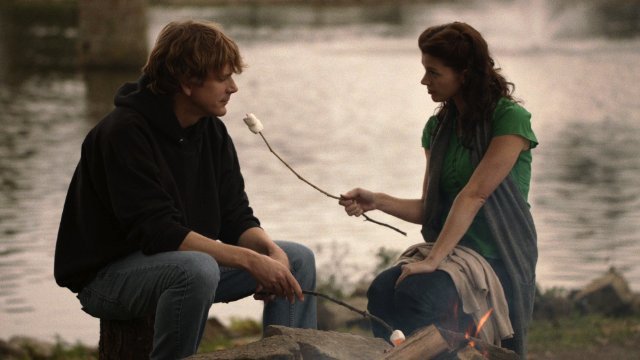
Old Fashioned, which came out on the same day as Fifty Shades of Grey (remember this detail; it will be important later), tells the story of a rigid, introverted man named Clay who owns his aunt’s antique shop.  When an innocent, free-spirited woman named Amber becomes a tenant above the antique shop, the two develop an odd friendship that slowly but surely works its way into a chaste courtship in contemporary America.

Clay is a guy who gets in his own way with his strict theories on love and romance…and so does this movie.

The Hits
There are some gems to be found in this film.  For one, the color palate is something to be admired.  Because Old Fashioned embraces the simplisticity of its premise, the backgrounds are colored with earth tones with the lighting scheme of a late-afternoon sunset.  This color palate gives the film a cozy, little-town feel that I greatly appreciated.  In fact, one shot of a sun rising was so gorgeous that I actually took a picture of it on my phone.  I will post the picture on the Catholic Girl Bloggin’ Facebook page.
The two leads, Clay and Amber, have genuine chemistry.  Their interactions are believeable and their archs are well-defined.  Amber is just a delight.  She’s written less as a shallow modernist and more as a go-with-the-flow optimistic nomad who chases happiness and adventure.  She’s like Elizabeth Gilbert from Eat Pray Love; seeking new life after a doomed relationship.
Something else I really liked is that this Christian film attempts to show the two extremes of faith.  A loose faith leads to inconsistency and aimlessness.  A rigid faith leads to stagnation and resentment.  This is a rare and noble message that needs to be showcased more in Christian films.
The story itself is unique on paper; an age-old courtship in modern society can make for a great story when done right.  But when executed poorly…(sighs) well, here are my points of frustration with this film.

The Misses
Some of the editing choices are just off-putting.  This movie likes to have Clay and Amber talking, and then show a separate scene with Clay running on a track field because–potatoes!–or have Amber walk across a bridge because–banana!–and these odd transitions are going on WHILE Clay and Amber are in the middle of a conversation in the present day.  That kind of editing is great for the trailer, but it gets so distracting in the final product.
Speaking of Clay….oh, boy.  I’m sure the actor playing Clay is giving it his all, but his line delivery is so stilted.  It seriously felt like he was just reading off cue cards. Where Amber feels like a fleshed-out character who could exist in real life, Clay has the vibe of a character who was created to promote an agenda.  The rigid, introverted traditionalist arch can work, but because his dialogue consists of pro-courtship slogans and the delivery of those lines is borderline robotic, I could not for the life of me connect with Clay’s character.
Why did I bring up that this movie came out on the exact same day as that cinematic cancer we humans call “Fifty Shades of Grey?”  Because it’s quite obvious that this movie exists as a counter to Fifty Shades.  I recently wrote an op-ed titled “Putting a Hashtag on Human Life,” in which I talked about the animosity between the #BlackLivesMatter camp and the #AllLivesMatter camp.  One of the things I said was, “#AllLivesMatter is tainted by its own inception: It was created for the sole purpose of opposing #BlackLivesMatter and had no further vision.”  Old Fashioned has this exact same problem.  This movie exists because Fifty Shades exists.  As a result, it feels as though the ideas are trying to be the story, not the story trying to have ideas.

Overall Old Fashioned is a well-intentioned, even innovative film that falls short because of its inception.  Despite its shortcomings, it is a good start to the depiction of courtship in cinema.