Strong, Brave Bear: Saint Bernadette Soubirous

Given that I love all things Saints, I collect various items such as Saints cards and statues.  The item that started my Saint collecting hobby was my statue of Saint Bernadette.

12804614_1113836068649920_8629422350780319039_n (2)


I have had this statue since I was a baby.  I became anemic shortly after I was born, so along with being given iron drops, my feisty and faith-filled Grandma Joanie handed my mother the Saint Bernadette statue and said, “Put this above her crib and ask Bernadette to pray for her.”  My mother did just that and asked Saint Bernadette, who suffered from poor health her whole life, to pray for my health as a baby.
As I was preparing to write this bio on Bernadette, a blood vessel broke in my left eye, so like my mother and grandmother had, I asked Saint Bernadette to pray for the healing of my eye.
The red spot in my eye disappeared by the time I started writing this piece.
I like to think that this post is my way of repaying the holy girl who has prayed for me in the past and in the present.
This is the story of Saint Bernadette Soubirous!
Saint-Bernadette

On January 7th, 1844, a baby girl was born to a miller named François Soubirous and his wife Louise.  Gazing into the eyes of their first child, they gave her the name Marie-Bernarde.  She was known by her nickname “Bernadette,” which means “strong, brave bear.”  The troubled early years that awaited her would require her to be strong and brave.
After enjoying years of comfort and prosperity, a series of misfortunes had befallen the Soubirous family.  Francois and Louise had eight more children after Bernadette; four of whom died shortly after entering the world.  Enduring the pain of losing brothers and sisters was just one of many crosses the young girl had to bear.  Then, like Jean Valjean, Francois Soubirous was arrested on suspicion of stealing a single wood plank.  He was later released without being charged, but his initial arrest was a huge blow to the Soubirous family’s social reputation and their bank account.  By 1858, the financial situation of the Soubirous family was so desperate that they had to live in an old jail called le cachot, or “the dungeon.”
To call Bernadette sickly would be an understatement.   As a toddler, she was hit with cholera and barely survived.  Due to the dampness of le cachot, she suffered from asthma her entire life.  To add insult to injury, at the age of 14, she was studying basic catechism in a room full of seven-year olds.

February 11th, 1858 started off like any other day.  Bernadette, her sister Marie and a friend of theirs were collecting firewood.  I think I’ll let Bernadette tell us what she saw:

I came back towards the grotto and started taking off my stockings. I had hardly taken off the first stocking when I heard a sound like a gust of wind. Then I turned my head towards the meadow. I saw the trees quite still: I went on taking off my stockings. I heard the same sound again. As I raised my head to look at the grotto, I saw a Lady dressed in white, wearing a white dress, a blue girdle and a yellow rose on each foot, the same color as the chain of her rosary; the beads of the rosary were white.”

Like any teenager would, Bernadette went home and told her friends, who in turn talked to her parents about what she had said.  Francois and Louise were understandingly disturbed and forbade Bernadette from going back to the grotto.  Bernadette respected their wishes and stayed away from the grotto.  However, she felt compelled to return to the place where she had seen what she called “Aquero,” which means “that” in Occitan, the language of her region.
After Sunday Mass on February 14th, Bernadette, Marie and a few other girls headed back to the grotto, where Bernadette saw Aquero again.  She knelt to the ground immediately and fell into a trance.  Clutching a bottle of holy water in her hands, she thrust holy water in Aquero’s direction.  ‘If it’s a demon, it’ll flee,’ she thought.
Aquero simply smiled.
Bernadette returned home with her sister with the resolve to visit the grotto once more.
On February 18th, seven days later, Bernadette ventured to the grotto.  She had to know.  She had to see for herself whether this mysterious figure was true or nothing more than a figment of her imagination.   Standing in front of the grotto, her focused eyes waited for the Lady.   Within minutes, Aquero was there.  The peasant girl stared in awe of the shimmering woman.  It was then that the Lady spoke.  She requested that Bernadette return to the grotto every day for a fortnight.

“She could not promise to make me happy in this world, only in the next.”

From there, rumors of Bernadette’s vision made way through the small town.  It started when her sister spread word to her friends, who then passed it on to their parents; think of it as the 18th century version of the telephone game.  Before she knew it, Bernadette had become a controversial figure in Lourdes.  In one corner, she had her supporters who swore, “This child is a visionary!  A prophet!”  In another corner were her detractors who declared, “She is mentally ill!  She must be sent away!”  That an impoverished girl who couldn’t even spell her own name had been visited by a messenger from God was an outrageous notion.   To put this into perspective, imagine if Bernadette was a teenage girl living today in our social media age.  You know that little corner of your newsfeed where it says “TRENDING“?  If the Lourdes apparitions were happening now, you would see “Bernadette Soubirous” right underneath “TRENDING” every single day.
Before she knew it, her name and story had made it to the ears of county government officials…

February 21st, 1858
“Come in, Ms. Soubirous,”
Bernadette’s trembling hand twisted the knob.  Pushing open the door, she saw Commissioner Dominique Jacomet.  Tall and well-dressed, the professional man of the law stared down at the simple girl, who stood cloaked in an array of patched fabric.  Shaken but resolute, Bernadette sat across from Jacomet, ready for the questions that were sure to come her way.
JACOMET: (Prepares notes) “Did you see something Ugly?”
BERNADETTE: (Shakes head) “Oh, no! I saw a beautiful young girl with a rosary on her arm.”
JACOMET: (Raises eyebrow) “Well, now, Bernadette, you saw the Blessed Virgin?”
BERNADETTE: (Looks with confusion) “I never said I saw the Blessed Virgin.”
JACOMET: (Smiles) (Points at BERNADETTE) “Ah, well!  You say nothing!”
BERNADETTE(Knuckles tighten) (Gives insistent nod) “Yes, I saw something.”
JACOMET: “Well, what did you see?”
BERNADETTE: “Something white.”
JACOMET: “Was it some thing, or some one?”
BERNADETTE: “Aquero has the form of a young girl.”
JACOMET: “And Aquero did not say “I am the Blessed Virgin”?”
BERNADETTE: “Aquero did not say that to me.”
JACOMET: “All right then, this lady..er. this girl, she wears clothes?”
BERNADETTE: “A white dress, with a blue sash, a white veil on her head and a yellow rose on each foot… and rosary beads in her hands.”
JACOMET: “Is she Beautiful?”
BERNADETTE: “Oh, yes sir, very beautiful.”
JACOMET: “As beautiful as who? Madame Pailhasson?”
BERNADETTE: (Chuckles sweetly) “They don’t even come close.”
JACOMET: “How old is she?”
BERNADETTE: “Young.” (Pauses) “But sir, I saw Aquero a number of times. I can’t still be mistaken.  I can’t explain it, but I’m sure I saw something.”
JACOMET: (Rises from his chair) “Listen, Bernadette, everybody’s laughing at you. Everyone says you are mistaken, that you’re crazy.  For your own good, you must not go back to that grotto!”
BERNADETTE: (Locks eyes with JACOMET)“I promised to go for fifteen days.”

It had been during the third apparition when Aquero said in Bernadette’s native Occitan, “Boulet aoue ra gracia de bié aci penden quinze dias?”  In English, this translates to, “Would you have the goodness to come here for fifteen days?” Even when confronted by Jacomet, Bernadette stood by her promise.
The apparitions that started on February 11th continued until July 16th in 1858.  Bernadette never missed a day.  With each day, the grotto became the place to be.  People gathered to watch Bernadette’s interactions with the mystery Lady.  During one of her encounters, Bernadette was asked by Aquero to go drink at the fountain and wash herself.  There was just one problem: There was no fountain, only a Gave (a hollow corner).  Bernadette began to dig, muddying her hands until she finally came across water.  A few days later, the spring began to flow from the Gave.
Aquero’s next task for Bernadette was to go to the priests and tell them to go in procession to the grotto and build a chapel there.
Bernadette turned to Father Dominique Peyramale, who dismissed her and ordered her to not return to the grotto.  She remained persistent and began pestering other priests about Aquero’s request.  With a grudging respect for the girl’s determination, Father Peyramale spoke with her again.  “No chapel is being built until we know the woman’s name,” he explained sharply.
Any time Bernadette would ask Aquero for her name, the Lady would respond with a smile.  It wasn’t until March 25th when Bernadette pressed Aquero with a little more force for her name.
Aquero stopped smiling.  Lowering her arms, her radiant eyes raised to Heaven.  She folded her arms over her breasts and spoke.
Bernadette’s eyes widened.  A gasp escaped her lips.  Within her racing heart, she felt the light of clarity.  Rising to her feet, she stood struck by the realization that she was a part of something greater, a grand plan that surpassed her finite understanding.
Holding her rosary close to her heart, Bernadette turned to the crowd, “I am the Immaculate Conception.”  That is what Aquero, the Blessed Virgin Mary, had said to her.
Shaken by this revelation, Father Peyramale, now a believer in Bernadette’s experience, made a trip to visit the bishop, who forbade him from going to the grotto.

The final apparition occurred on July 16th.  The Virgin Mary greeted Bernadette with a motherly gaze.

“All I saw was Our Lady.  She was more beautiful than ever.”

Bernadette disliked all the attention she had garnered, so she attended a hospice school run by the Sisters of Charity of Nevers.  It was here that she finally learned how to write and read (even how to spell her own name!)  Discovering that her true vocation was the religious life, Bernadette set her sights on the Carmelites, but her poor health made her ineligible for stricter orders.  On July 29, 1866, Bernadette was one of 42 women to take the religious habit of postulant and join the Sisters of Charity.  The Mother Superior bestowed upon her the name, “Sister Marie-Bernarde.”
Bernadette’s remaining years were spent as an infirmary assistant, then later a sacristan.  Sadly, she had to endure ridicule from other sisters who were skeptical about her apparitions.  She was given harsher discipline, for the Mother Superior wanted to prevent her from becoming prideful.  Having been obedient to the Virgin Mary, Bernadette held up her head and did exactly as she was told.
Bernadette’s health was struck by tuberculosis in the bone of her right knee.  She did as much work as she could until the tuberculosis made her unable to go on any longer.   On April 16, 1879, 35-year old Bernadette Soubirous lay on her deathbed, suffering terribly from the pain.  With her last breath, Bernadette prayed aloud her final words:

“Blessed Mary, Mother of God, pray for me!  A poor sinner, a poor sinner!”

Have you been researching someone’s life and the more you learn, the more you come to love them?  As Saint Lucy and Saint Agnes are my sisters, so too is Bernadette.  I am in awe of her humility and bravery to stand alone in her convictions, which is a rarity in modern society.  She never caved to the pressure to change her story or stay away from the grotto.   It is no coincidence, it was part of God’s plan, that her name means “strong, brave bear.”

Saint Bernadette Soubirous, pray for us.

CGB Reflections: What It Means To Stand Alone

10206819505_03c7027a1a

It is nice to be surrounded by likeminded people.  As human beings, it is natural for us to desire being around those who think like we do.  There’s nothing wrong with that.  God placed in our hearts a need for community so that we would not live in isolation.

However, we also come across people who we respect, but don’t agree with.  In this case, we have two options: Disassociate with them and remain in our own echo chamber or put aside political differences and welcome each other’s friendship.

Now let’s go even further.  What happens when you discover that your closest friend of many years is on the other side of an issue you deeply care about?  What if the majority of your co-workers support a proposed piece of legislation that you oppose or vice versa?
What if, on a hot-button issue, you don’t see eye to eye with a relative or maybe even with your entire family?

There will come a time in your life where you will be confronted with two options: Become a member of the tide or stand alone as a master of your convictions.  Believe me, it is a very difficult decision.   To disagree with the people in your life is not a rejection of them.  Rather it is a test of how you will handle times of controversy and opposition.  Unfortunately, people will misunderstand you.  Our society is so divided that disagreement is often perceived as a personal attack.  You may be shunned at work, lose a friend, or have your loyalty questioned by your family; these are the realities of going against the grain.

God tests us in this way to see whether we are ruled by fear or courage.  He wants to see if we will go along with the opinions of others for the sake of keeping the peace or if we will be bold enough to follow our conscience when it contradicts the conventional narrative.  He places these challenges in our lives to know if He can count on us to stand up for His Word, even if it means being a lone advocate.

We are all pilgrims passing through this life.  Our souls were made for Heaven, not earth.  At the end of our lives, we will stand before God.  You will face Him and so will I.   He will have many questions for us; one of those questions will be this:

“Did you stand with the world or did you stand with Me?”

What will your answer be?

“Do not think that I have come to bring peace upon the earth. I have come to bring not peace but the sword. For I have come to set a man against his father, a daughter against her mother, and a daughter-in-law against her mother-in-law; and one’s enemies will be those of his household.”
–Matthew 10:34-36

“There comes a time when one must take a position that is neither safe, nor politic, nor popular, but he must take it because conscience tells him it is right.”
―Dr. Martin Luther King Jr.

Saint Bernadette Soubirous, pray for us.


CGB Review of Risen (2016)

Spoiler alert: Jesus rises from the dead.  Gasp!

This is my review of Risen!

Joseph-Fiennes-in-Risen

After the Crucifixion, Jesus’ body has been entombed.  However, three days later, His body goes missing.  Tribune Clavius, played brilliantly by Joseph Fiennes (younger brother of Harry Potter actor Ralph Fiennes), is tasked by Pontius Pilate to find the missing body in order to prevent an uprising from Jesus’ followers.
Christian films are a hit or miss genre.  Sadly, the genre is known for its misses rather than its homeruns.  I am glad to say that Risen is definitely an excellent hit in the genre.

The Hits
Joseph Fiennes deserves, at the very least, Oscar consideration.  His expressive face and intense eyes sell the seething persona of Clavius.  He can be both intimidating and approachable.  He commands the screen with a silent performance similar to Leo DiCaprio in The Revenant.  His conversion is a reluctant, gradual turn that is brought full-circle by Fiennes’ mesmerizing performance.  I commend the film for essentially making Clavius a nonbelieving character without vilifying his unbelief.
I like how Pontius Pilate is haunted by “the Nazarene” while still being a shady, self-centered politician.  I appreciate that he doesn’t have a change of heart because this is something many people experience; refusing to change their ways after an event shakes their corner of the world.
Yes, Tom Felton (Draco Malfoy) is in this movie.  At first, I was very concerned that he would be a distraction.  I’ve only seen him in the Harry Potter films, so I only know him as Draco.  Thankfully Tom Felton has the right amount of screen time.  The movie doesn’t use his celebrity as a crowd-grabbing gimmick.
Jesus Himself is seen on the cross in the first ten minutes and then doesn’t show up until the beginning of the third act.  I think this was a wise move.  Jesus’ presence is felt throughout the film.  His name brings fear to His opponents and joy to His followers.  His memory holds strong in Clavius’ mind.  This strategy is brilliant because when Jesus does show up, there is appreciation for His long-awaited return.  While the actor playing Jesus does come off as a bit of a hippie, it is a respectful portrayal that concentrates on Jesus’ merciful nature.   Also the guy who plays Saint Peter is wonderful, a big brother type who brings some light humor while remaining believable as the one Jesus entrusted the Church to.

The Misses
The last twenty minutes do feel stretched out.  Risen has what I call “Return of the King” syndrome in which right when the movie seems like it is coming to its conclusion, a new scene will begin and the film keeps going.
For moviegoers who prefer more fast-paced cinema, Risen might feel a tad slow.  It is a character study of Clavius’ internal conflict and there are very few action sequences.

Risen was a pleasant surprise.  What makes it an intriguing narrative is the humanistic portrayal of the characters, Joseph Fiennes’ incredibly subtle performance and the graceful handling of Jesus’ death and resurrection.

Saint Faustina Kowalska, pray for us.

CGB Book Review of The Screwtape Letters (1942)

“To get a man’s soul and give him nothing in return–that is what gladdens our Father’s [Satan’s] heart.”
–Screwtape

Holy cow, if that’s not downright diabolical, I don’t know what is.

This is my first ever book review of C.S. Lewis’ The Screwtape Letters!

screwtape-letters-by-izabela-wojcik (2)

Screwtape is a senior Demon whose nephew Wormwood, a junior Tempter, is working on securing the damnation of a man called “The Patient,” who has recently converted to Christianity.  The cunning Screwtape instructs Wormwood via a series of letters that illustrate the strategies of Satan which are used to lure the human race away from God and into the darkness of Hell.
Ever since I started Catholic Girl Bloggin’, I have dealt with spiritual warfare.  Without going into too much detail, I will say that being picked on by the devil is unpleasant at best and frightening at worst.  Reading the Screwtape Letters has been both chilling and enlightening for me.  To put this into perspective, imagine being bullied by someone for a long time and after they die you get a hold of their diary.  As you’re reading it, you say to yourself, “So that’s how they pulled it off.  It all makes sense now.” A lot of Screwtape’s temptation tactics are things that I have personally experienced.
With that, let’s take a look at The Screwtape Letters!

The Hits
C.S. Lewis was one of the most brilliant minds in literature, but he knew how to make his words accessible while remaining sophisticated.  While at times, his British jargon can get a tad confusing, the majority of what he writes is simple enough for anyone to grasp.
Many of the passages in this book are very timely.  In one letter, Screwtape tells Wormwood, “A moderated religion is as good for us as no religion at all—and more amusing.” In our world today, “liberal” churches have emerged with a watered-down version of God’s Word mixed with a progressive agenda.
Another letter has Screwtape advising Wormwood, “Man has been accustomed, ever since he was a boy, to having a dozen incompatible philosophies dancing about together inside his head.  He doesn’t think of doctrines as primarily “true” or “false,” but as “academic” or “practical,” “outworn” or “contemporary,” “conventional” or “ruthless.” Jargon, not argument, is your best ally in keeping him from the Church. Don’t waste time trying to make him think that materialism is true!  Make him think it is strong or stark or courageous—that it is the philosophy of the future. That’s the sort of thing he cares about.”  C.S. Lewis is clearly speaking about moral relativism; the belief that truth is subjective and can be changed to accommodate the times.
Something I found interesting is the subtle world-building of Hell.  Screwtape briefly mentions the Infernal Police, which is the underworld equivalent of the KGB.  He also talks about enclosing a booklet on the newly constructed House of Correction for Incompetent Tempters.  The addition of other background characters like Slumtrimpet and Fr. Spike help expand the worlds of both Screwtape and Wormwood, and The Patient. I also appreciate how Satan is an unseen antagonist; he is mentioned many times in the letters without ever making an appearance as an active character.  The focus of the novel is Satan’s methods being told to us through the seasoned Screwtape.
Speaking of Screwtape and Wormwood, I like their parasitic relationship.  Animosity is cleverly hinted between the two, and the self-serving Screwtape clearly sees Wormwood as just another necessary tool of damnation.  There is no “like” or “love” where they reside.
By far, my favorite passage in the Screwtape Letters is this, “The man who truly and disinterestedly enjoys any one thing in the world, for its own sake, and without caring two-pence what other people say about it, is by that very fact forewarmed against some of our subtlest modes of attack.” God is the source of true and lasting joy, so when we engage in an activity that brings us joy (reading a book, taking a walk, spending time with a close friend, etc.,) we are placing ourselves in His presence.  Disordered sources of temporary pleasure and distraction come from the devil.  Screwtape even comments, “I have known a human defended from strong temptations to social ambitions by a still stronger taste for tripe and onions.”  I will say that I feel closest to God when I am writing a story or a CGB post.  🙂

The Misses
I really wish that “The Patient” was given a name.  I understand that the point of an unnamed protagonist is that The Patient could be anyone, but it prevents an emotional connection with the character.  .
For the Americanized reader, some of the British slogan may be a bit distracting and may make it difficult to properly put the scene into context.  I had to reread some of the passages twice because I had trouble interpreting what Mr. Lewis was trying to say.

The Screwtape Letters is a Christian classic for a reason.  Written with wit and valuable insight into how evil operates, it stands the test of time with relevant observations regarding how society can be led astray without even realizing it.  If you ever wondered why C.S. Lewis never wrote a Screwtape Letters Part 2, it has been documented that he simply could not bring himself to return to the dark state of mind necessary to create the dialogue between two demons.

Saint Gemma Galgani, pray for us.

I Am The Handmaid of the Lord: Blessed Virgin Mary

The CGB Saints posts are back!  The last Saints post I did was on Saint Rose of Lima and now that I’m off from school until February, why not kick off 2016 with the triumphant return of CGB Saints posts?!  🙂

I decided to reopen this segment with a Super Saiyan Saint, the Queen of Heaven and Earth herself…

virgin-mary-pics-0917

Once upon a time, in the Galilean town of Nazareth, there was a girl named Mary.  She was the only child of Anne and Joachim.  We can assume that she lived the typical life of a Nazarene girl.  She said her prayers every night, carried water from the local well, tended to her father’s animals, helped her mother clean up after dinner, and so on.  When we meet Mary in the New Testament, she is betrothed to Joseph, the carpenter who everyone respected.  By all accounts, everything was going well in Mary’s life.  Her parents adored her, her fiancée was a hard-working gentleman, and she had a squeaky-clean reputation among her fellow Nazarenes as being Anne and Joachim’s sweet, polite daughter.

If there’s one thing I’ve learned in my twenty-four years of life, it’s that God likes to make a grand entrance on our lives when everything is a little too steady and certain.

Meet Gabriel the Archangel.  He is the messenger chosen by God to deliver a very important message to the Nazarene girl.  This is how I imagine that conversation went:
GOD: Everything is in motion, Gabriel.  Mary’s engaged to Joseph, she’s just the right age–she is ready.
GABRIEL: Okay, my Lord, do you believe she will accept?
GOD: (smiles) Go to Nazareth, Gabriel.  It is time.

Mary is home alone.  Anne and Joachim have gone into town to run some errands.  Luckily, Joseph is just down the road if Mary needs anything.
She wipes the last dirty dish with an old rag.  She looks up at the window, relishing the warmth of the sunlight as it pours onto the walls of her humble abode.  She turns around and freezes.
“Rejoice, O highly favored daughter!  The Lord is with you.  Blessed are you among women.” Gabriel announces.  A trembling Mary stares at the mighty angel.  An angel?  Here in Nazareth?  What does he trying to tell me? she wonders.
Sensing her troubled thoughts, Gabriel lowers himself just inches above the ground, “Do not fear, Mary.  You have found favor with God.  You shall conceive and bear a son and give him the name JESUS.  He will be called Son of the Most High.  The Lord God will give him the throne of David his father.  He will rule over the house of Jacob forever and His reign will be without end.”
Mary shakes her head in disbelief, “How can this be since I do not know man?”
Gabriel smiles gently, “The Holy Spirit will come upon you and the power of the Most High will overshadow you; hence, the holy offspring to be born will be called Son of God.  Know that Elizabeth your kinswoman [cousin] has conceived a son in her old age; she who was thought to be sterile is now in her sixth month, for nothing is impossible with God.”
Mary is assumed to have been thirteen or fourteen when the Annunciation took place.   She was old enough to have an understanding of what was being asked of her, but was also still a young girl with her whole life ahead of her.  To have an angel basically tell her that God has chosen her to carry His child had the potential of derailing her life plans.  Would her parents believe her?  Would Joseph stand by her and take her as his wife?  How would the other Nazarenes react?
There were no crisis pregnancy centers in Mary’s day.  Outreach efforts to pregnant teenagers was nonexistent.  Everyone would assume that Mary had relations with another man and she could find herself in the town square, having stones hurled at her from angry townspeople.
Mary may be the mother of God, but she was still human.  It is possible that these consequences raised her levels of anxiety.
However, Mary also knew of God from her parents.  She had learned that God was wise and righteous.  Within her heart, Mary had the grace to realize that to find favor with God meant that whatever He wanted her to do, He would help her accomplish it.  She had a feeling that God did not want to destroy her, but to invite her to take part in something greater than herself.
This is the best explanation as to why Mary, a teenage girl, would so readily say to Gabriel, “I am the handmaid of the Lord.  Let it be done unto me according to Your word.” Gabriel left her, his task complete.

Shortly after accepting her mission, Mary took a trip to the town of Judah.  Mind you, there was no Uber ride service in her day.  Also, Elizabeth and Zechariah had no way of knowing that Mary was on her way.  To quote my mentor Fr. Dave, “She couldn’t send a text.  She couldn’t send an email or a message on Facebook.  She couldn’t call Elizabeth and say, ‘Oh, hey, cousin, I’ve heard that you’re pregnant.  I’m on my way!'”
It is not clear how long it took Mary to get from Nazareth to the city of Judah.   It has been approximated that the journey was about 130 km or 80 miles.
What matters is that she got there and so begins the Visitation, the event in which Mary meets with her cousin Elizabeth, who is six months pregnant with a son.  When Elizabeth saw Mary, she exclaimed, “Most blessed are you among women, and blessed is the fruit of your womb.  And how does this happen to me, that the mother of my Lord should come to me?”  In that moment, the child in Elizabeth’s womb leapt for joy.  The unborn child, who we know to be John the Baptist, knew that the Son of God was in their midst.
Mary stayed with Elizabeth until John was born.  By this time, Mary was three months along in her own pregnancy.  She returned home to her mother, her father, and Joseph.

Yes, Joseph did learn of Mary’s pregnancy.  While I do go into detail about this in my Saint Joseph post last year, I will briefly summarize Joseph’s turmoil.
As we can imagine, the circumstances of Mary’s pregnancy were hard for even Joseph, a man of steadfast devotion, to believe.   He loved Mary and figured that the best way to protect her would be to divorce her quietly.
One night, as Joseph slept, an angel appeared to him in a dream.  This angel told the carpenter, “Joseph son of David, do not be afraid to take Mary home as your wife, because what is conceived in her is from the Holy Spirit.  She will give birth to a son, and you are to give him the name Jesus, because He will save His people from their sins.”  If there’s one thing Joseph knew for sure, it is that when an angel tells you something is true, then it’s best to take their word for it.
Joseph and Mary were wed soon after.  For all everyone knew, the child in her womb was his and all seemed well.
Roman Emperor Augustus issued a decree that forced Joseph to return to Bethlehem, his hometown, in order to register for a Roman census.  By this point, it has been five months since Mary visited Elizabeth and she is beginning to show.  Joseph and Mary set off for Bethlehem, with Joseph leading his family on foot while Mary sat on their donkey (which can’t be comfortable for a pregnant woman).   According to Fr. Oscar Lukefahr, author of “Christ’s Mother and Ours: a Catholic Guide to Mary” it was a three day journey, approximately 70-80 miles. 

Mary lifted her veil to her face, trying to keep the wind and rainwater from her eyes.  As they entered into Bethlehem, mild discomfort turned to pain.  The time for Mary’s child to be brought into the world was drawing near.
Joseph sprinted to every house, the mud sticking to his sandals.  “Help, help!  Please, we need shelter!” he pleaded to every person who opened their door.
No one would take them in.  All doors were closed to the Holy Family.
An inn keeper offered to let them stay in the manger where the animals resided.  As Mary’s contractions grew stronger, Joseph rushed his wife into the manger.
On that cold winter’s night, the Son of God was born.

While Mary’s story certainly doesn’t end here, the purpose of this piece was to humanize this woman who fearlessly accepted a great calling from God.  Mary was not afraid to be inconvenienced, to have her typical Nazarene life turned upside down.  She knew the risks that would come with her “Yes.”  She knew that her world would never be the same.
If she could do it all over again, Mary would say “Yes” in a heartbeat.

Saint Mary of Nazareth, pray for us.

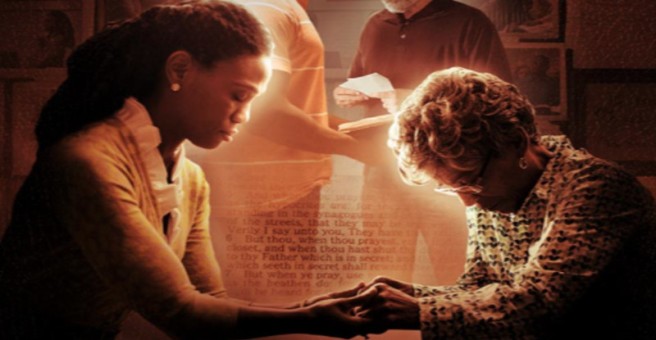
CGB Review of War Room (2015)

Hmm, a Christian film about trying to save one’s marriage with prayer.  Hey, Kendrick brothers, you’ve made this movie before: It’s called Fireproof…
And it was way better than this flick.

This is my review of War Room!

war-room

War Room is the latest film from Alex and Stephen Kendrick, the same guys behind Flywheel (2003), Facing the Giants (2006), Fireproof (2008) and Courageous (2011). The best way to summarize this film is it’s basically Fireproof from the wife’s point of view and with an old lady thrown into the mix.

The last Kendrick brothers movie that I reviewed here on CGB was Courageous, which was made to be a pro-fatherhood film, but sadly, ended up being a poorly-paced, unfocused narrative.

Let’s see how War Room holds up!

The Hits
This is one of the very few Christian films that attempts to tackle spiritual warfare.  Given that Satan’s influence is considered taboo, I do commend this film for taking on the fight against the devil.  There’s a great scene where Elizabeth is confronting the devil, telling him to leave her family alone and that God is in charge of her household.  I was actually invested in this one sequence.
Unlike Courageous, the pacing in this film is much better.  Hence they’ve learned something since Courageous.  There’s still some filler here and there, but those are few and far between.  Scenes don’t drag on, the plot stays focused for the most part, and the acting is actually pretty good.  So War Room is a slight improvement in terms of the technical aspects.  Also, while I did find Miss Clara’s character to be a bit abrupt and intrusive, I can tell you that feisty old ladies have earned the right to have no filter.  🙂

The Misses
I hate to say it, but a lot of secular critics were right when they said, “The message of this movie is that if your spouse doesn’t treat you right, it’s because you’re not praying hard enough.”  Yep, that is exactly how the first hour of this movie plays out.   There’s even one scene where after Elizabeth vents about her husband Tony, Miss Clara snaps, “Everything you’ve said about your husband is negative!”  Well, yeah, because the first act shows Tony berating Elizabeth in front of their daughter Danielle and then making hurtful remarks to Danielle about how she’s too old to be jump-roping (she’s part of a jump-roping team).  He also scolds Elizabeth for taking money out of their account to help her (off-screen) financially-troubled sister and tells her that their money is his money.
To understand why this movie is frustrating, let’s first look at why Fireproof worked.  The script had both spouses biting at each other’s ankles, not one unreasonably cruel spouse constantly tearing the other submissive spouse.  Caleb and Catherine both gave each other grief and, while Caleb had to do a lot of the work to save their marriage, Catherine was also challenged to forgive her husband.  I’ve never been married, but even I know that marriage is a team effort.  It takes two to tango, after all.
So why does War Room fail at where Fireproof succeeded?  Because the husband Tony is verbally and even financially abusive towards Elizabeth.  Their daughter Danielle is also a victim of Tony’s emotional abuse.  By the way he treats them, it comes across that Tony flat-out hates his own family.  Elizabeth doesn’t do anything to get him worked up.   Also, I did cringe when Elizabeth tells her gal pals, “I just don’t know how to submit to him…” Yeah, it’s generally a bad idea to have a female character say something like this.
Look, Kendrick brothers and every other Christian filmmaker, I can totally get on board with using cinema to combat the alarmingly high divorce rate in this country, but if you’re going to make movies about defending the indissolubility of marriage, please learn the difference between a flawed spouse and an abusive one.  I get that we’re trying to teach our generation to fight for their marriages and not throw in the towel, which is a noble cause, but when it is presented incorrectly, it can come across that Christian films are advocating staying in toxic relationships.

I do commend this film for taking on spiritual warfare and for its message of the power of prayer.  However, its mishandling of a dysfunctional relationship is troubling enough to keep me from recommending War Room.
If I ever have a daughter and she wanted to watch this movie, I would say “absolutely not, Gemma or Gianna or Scholastica Ecclesia” or whatever I name her.
In all seriousness, keep your daughters away from this movie.

Saint Monica of Hippo, pray for us.

What We Stand For: A Brief Reflection on The Colorado Springs Planned Parenthood Shooting

newborn-3

I’m sure by now you have heard of the Planned Parenthod shooting that took place in Colorado Springs yesterday.  However, just for emphasis, I will summarize it:
At 11:38 local time, 57-year old Robert Lewis Dear burst into the Planned Parenthood clinic in Colorado Springs and opened fire. The staff and patients took cover in closets and bathrooms.
Police were engaged in a standoff with Robert Lewis Dear that some sources say lasted five hours while other sources state lasted for six hours. Officers continued to encounter gunfire as they evacuated the people who had taken cover.
The standoff ended when Robert Lewis Dear surrendered.

Since yesterday I have been taking to Facebook and joining the flood of pro-life groups and advocates who have been condemning Robert Lewis Dear’s act of violence against Planned Parenthood.  However, that hasn’t stop detractors from using this tragedy to blame pro-life activists and smear our cause.  For me, the biggest blow came when Buzzfeed posted an article entitled, “Some Abortion Foes Cheered the Planned Parenthood Shooting.”  http://www.buzzfeed.com/rachelzarrell/some-pro-life-supporters-cheered-planned-parenthood-shooting?utm_term=.uoAz1YPPe#.ggM0eMww9

After that, I just logged off and took some time to take a breath.  My heart was already heavy from what happened in Colorado Springs, and to see a cause I care for being slandered was even worse.
I went to our living room and sat in front of the Christmas tree, staring at the ornaments and lights.  “Why should I even bother?” I asked myself. Why should I even bother to keep posting about how pro-life groups have condemned what happened in Colorado Springs if people will continue to paint us as violent extremists anyway?
I looked at our pictures of Jesus and Mary that hang side by side on our wall. I bore my eyes into Jesus’ image, concentrating at his upward gaze, his purposeful expression.

Then, somehow, I came to a distressing thought: ‘Why did Jesus even bother to die on the Cross?’

I had to sit down.  Jesus died for our sins, but we still sin anyway, so why would He bother?
The answer: Because Jesus’ mission was to save us.

This conclusion lifted me from my drained state.  Why should I bother to be vocal about defending the pro-life cause?
Because defending every life is our mission.

What others say about us doesn’t matter.  How society paints us is irrelevant.  Pro-life does not exist to please others.  Pro-life exists to protect the dignity of every single life.

Pro-life means defending the humanity of the unborn baby.
Pro-life means reaching out to the single mother.
Pro-life means offering hope to the pregnant teenager.
Pro-life means supporting the rape victim.
Pro-life means showing mercy to abortion clinic workers.
Pro-life means feeding and clothing the homeless.
Pro-life means welcoming the refugee.
Pro-life means standing up for the death row inmate.
Pro-life means giving shelter to abandoned animals.
Pro-life means every beating heart matters.
I will say this as many times as I need to: Pro-life does not stand for violence or extremism.  We do not stand for shaming women or abortion workers.  You cannot call yourself pro-life if you do not condemn violence against clinics or the people who work there.  Oppose abortion, but do no harm to those who support it.

Pro-life is pro-peace.
Period.


A Mother’s Love: Saint Monica

I was sixteen-years old when I was going through the Confirmation program. When it came time for me to pick a saint, I was torn between all the single saintly ladies: Teresa of Avila and Catherine of Siena were my top picks, but so were Agnes of Rome, Maria Goretti, and Cecilia.  Joan of Arc is cool, but Lucy of Syracuse is like a sister to me.  Then there’s my parish patron Kateri Tekakwitha to consider, but then again, Faustina Kowalska is the patroness of the Divine Mercy!  AAAAHHHHH!!!!
As you can see, I was quite stressed.  So many awesome ladies to choose from and I only had so much time.  I remember flipping through my Saints book in a panic.  I ended up dropping it and watched it cracked open on the tile.  When I picked it up, I saw the page on Saint Monica.
I skimmed through her chapter, “She doesn’t seem very interesting.”  She wasn’t a soldier like Joan or a martyr like Lucy, Maria or Agnes.  I put Monica on the backburner for a while.
However, the longer I resisted, the more she crept up on me.  One night I went online and read up on Monica.  I scratched my head, “God, why should I pick her?  We have nothing in common.”
At first glance, Monica and I were incompatible as candidate and patron.
She was a married woman.  I am single.
She lived in Africa.  I am a born-and-raised California girl.
She was an obedient old woman.  I am a headstrong young woman.
In spite of all these differences between us, I couldn’t bring myself to click out of her info page just yet.  So I sighed and took a second look at her story.

Saint Monica portrayed by actress Monica Guerritore in Restless Heart.

Saint Monica was born in 331 AD in Tagaste, which is now known as Souk Ahras, Algeria.  Not much is known about Monica’s childhood, but we do know that she was born after Constantine legalized Christianity.
You may have noticed that in a lot of my Saints bios, many of these guys and gals were either in arranged marriages (ex. Cecilia) or were arranged to be married to somebody (ex. Lucy).  Monica is no exception.
She was twenty-two (a year younger than me) when she was betrothed to a Pagan man named Patricius.  By all accounts, Monica was a generous and obedient girl, so she was married off without hesitation.
To put it simply, Monica got a pretty raw deal because Patricius was the biggest jerk in Tagaste.  Violent, with an explosive temper, he verbally and physically abused Monica during his outbursts.  To add insult to injury, he was the kind of guy who would be a regular Ashley Madison customer if he lived in the year 2015.  Oh, and did I mention that his mother/Monica’s mother-in-law also worse than Nurse Ratchet from “One Flew Over the Cuckoo’s Nest?”  Needless to say, the apple didn’t fall far from the tree.
Now, you’re probably thinking, “Ditch this guy, Monica,” but divorce court wasn’t a thing in AD Tagaste.  These were the days where a man could leave his wife if she wasn’t a virgin, but a woman was stuck with a hot-headed cheater.
Monica was a Christian and she was especially drawn to Christianity’s emphasis on kindness and humility.  She was also very smart, so she figured that if she couldn’t leave Patricius, she would kill him with kindness.  She knew she couldn’t fight back when he hit her because she would end up on the streets as a beggar woman, so she said her prayers aloud, ignoring him as he stormed off.   When he came home after visiting one of his “lady friends,” Patricius scratched his head when he saw a lavish meal prepared for him by the wife he was betraying.
Monica’s charitible approach won over Patricius’ respect and admiration, to where his punches became less frequent and he began walking out of the room instead of screaming at her.

Monica had three children with Patricius; Augustine, Navigius and Perpetua. There’s very little info on Navigius and Perpetua (I did find out that Navigius entered the monastery), but Augustine–oh, yes–there is a plethora of info on Augustine.  Why?  Because her Augustine just so happens to be THE great Saint Augustine of Hippo.  What a twist!
Monica did the best job she could at raising her children in the faith, but remember, Patricius was an aggressive Pagan and it was his way or the highway. Augustine was the oldest son and it’s not uncommon for the oldest son to gravitate towards his father.  This means that Augustine was very much his father’s son in his actions…and in his beliefs.
Monica knew that her son was a fast-learner, but her heart broke when she saw how disinterested he was in her Christian faith.  She was even more distressed when she realized that Paganism was more enticing to her impressionable son.

After years of being bound to his sinful ways, Patricius converted to Christianity on his deathbed.  However, Monica still had one more thing to do: Save her Pagan-party boy son!  (Plays Superman theme music)
When Augustine grew up, he traveled to Carthage.  In those days, saying “I’m going to Carthage” was like saying, “I’m going to Harvard.”  It was where all the great thinkers went to, well, think and trade abstract ideas.  It was also where many heresies and questionable theological theories sprang up and resided.  These ideas influenced Augustine and led him astray for oh-so-many years.  To his chagrin, Augustine wasn’t alone.  Right behind him on the boat to Carthage was his mother.

As she followed him on his travels, Monica witnessed Augustine’s sinful ways.  She watched him drink himself into a stupor on multiple occasions.  She watched him blaspheme against God and the Church.  She watched him impregnate a woman he wasn’t married to.  She watched him abandon the woman and their infant son.  Her heart broke with each sin.  Every day she offered up her son in prayer.  She asked God to forgive Augustine and to change his hardened heart.  Sometimes her prayers were calm and contemplative; other times they were shouted in desperation and anger. Every prayer came with tears for her wayward son.  Monica’s valiant praying caught the attention of Saint Ambrose, the bishop of Milan.  Monica went to him and poured out her story about the abuse she suffered and of her fear for Augustine’s immortal soul.  Ambrose was so moved by Monica’s courage and all that she had sacrificed that he assured her, “It is not possible that the child of so many tears should perish.”

Monica’s prayers finally paid off.  Augustine had a powerful “come-to-Jesus” experience that changed his life.  He abandoned his selfish ways and became a Christian.  Monica could live in peace at last.  She was called home to Heaven shortly after.

I Volunteer as Tribute: Saint Maximilian Maria Kolbe

As a Catholic fan of the Hunger Games, I can’t help but wonder if author Suzanne Collins was inspired by Saint Maximilian Kolbe to have Katniss take her sister Prim’s place in the 74th Games.
Well, Suzanne Collins is Roman Catholic…
Anything is possible, I suppose.

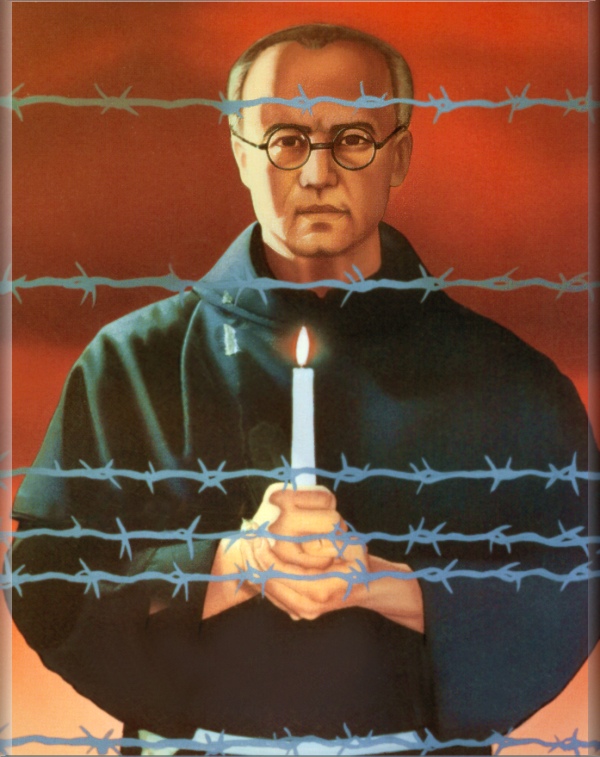
This is the story of Saint Maximilian Maria Kolbe!

kolbe

There once was a boy named Raymund, who was born in Zduńska Wola, Poland with his father Julius, his mother Maria and four brothers.  Not long after he was born, Raymund and his family moved to another town called Pabianice.
Raymund was an aimless boy; he went to school, helped out around the house, walked around town, etc.  He didn’t seem to have any particular talents that would make him famous or important by the world’s standards.

Then in 1906, the Virgin Mary appeared to him in an apparition that would change the course of his life forever.

“That night I asked the Mother of God what was to become of me. Then she came to me holding two crowns, one white, the other red. She asked me if I was willing to accept either of these crowns. The white one meant that I should persevere in purity, and the red that I should become a martyr.  I said that I would accept them both.”

Raymund joined the Conventual Franciscan minor seminary with his older brother Francis one year later.
Then in 1910, Raymund Kolbe entered the novitiate with a new name: Maximilian.

Now Maximilian and the Virgin Mary were BFFs.  After all, she saved him from a dull life as a directionless country boy by revealing his purpose in life.   Naturally whenever someone impacts your life in a positive way, you feel a desire to repay them and show your gratitude.
In Maximilian’s case, he felt so much love and respect for the Blessed Mother that he not only added “Maria” to his full name (Maximilian Maria Kolbe), not only did he openly promote the veneration of Mary, but he even started the Militia Immaculata (MI) in her honor.  The purpose of MI is to evangelize to the world and convert hearts by relying on Mary’s intercession.  In fact, to become a member of MI, you have to make a personal act of consecration to Mama Mary.
Yep, that’s the sexist Catholic Church; we’re so misogynistic that we canonized a guy who was inspired by a woman to change his life and then started an organization where members consecrate themselves to that same woman.
Just let that sink in for a moment.

Maximilian’s missionary work took him all over the world; China, Japan, and eventually to India.  For reasons unknown, he couldn’t gather a following in China, but he did get a lot of work done in Japan.  He build a monastery on the outskirts of Nagasaki.
Interesting trivia: The atomic bomb that was dropped on Hiroshima and Nagasaki obliterated everything in its path…except for the monastery that Maximilian had built.  In the midst of death and destruction, the monastery was still standing.
Even when tuberculosis forced him to end his travels and return to Poland, Maximilian remained active by starting a radio station in–(do not ask me how to pronounce this) Niepokalanow.
I’ll bet you Satan got ticked with Maximilian; “you have freaking tuberculosis; how are you still moving?  These Mary-loving types are always the hardest to axe off.”

Then everything changed when the Fire Nation–I mean–the Nazis attacked.  In addition to slaughtering innocent Jews, the Third Reich had a particular hatred of the Catholic Church and anyone associated with her (I say “her” because the Church is the bride of Christ).  Maximilian and four other priests were arrested on Feburary 17th, 1941.  When Maximilian was sent to Auschwitz, he was given another new name: Prisoner #16670.

One of the twisted policies of Auschwitz was that if a prisoner escaped, ten prisoners would pay with their lives.  So when three prisoners fled Auschwitz, ten men were randomly selected to spend their days in an underground bunker, where they would left to die from starvation and dehydration.
One of the chosen was Prisoner #26273, also known as Franciszek Gajowniczek.  In a panic, Franciszek cried out, “My wife!  My children!”  Haunted by the fear of leaving his wife to fend for herself with two fatherless child, he begged for mercy.  The Gestapo officers held their batons, ready to strike him to end his pleading.

A man with glasses and a long white beard stepped up and faced the Gestapo.
“I am a Catholic priest from Poland; I would like to take his place, because he has a wife and children.”
The switch was made and Franciszek was sent back in line to live another day.  Wiping off the sweat from his face, he turned to get a look at his rescuer, Father Maximilian Maria Kolbe.
During his final days, Maximilian kept his fellow prisoners in high spirits with prayer and fasting.  He evangelized to the men, giving them hope by telling them of Jesus and His mother Mary and praying with them.
Two weeks later, the guards entered the bunker to collect the bodies.  They froze when Maximilian Kolbe looked up at them, still alive.
A calm Maximilian lifted his left arm and received a deadly injection of carbolic acid.  His body was cremated on August 15th, the feast day of the Assumption of his beloved friend, Mary.

Saint Maximilian Maria Kolbe, pray for us.

Christian Movie Reviews: Do You Believe?

My Fant4stic Four review was written at 1 o’clock in the morning and despite being very tired, I pushed myself to talk about a movie that couldn’t care less about its own existence.
Now it is 11am, I am well rested and ready to review a risk-taking, gut-wrenching Christian film called Do You Believe?

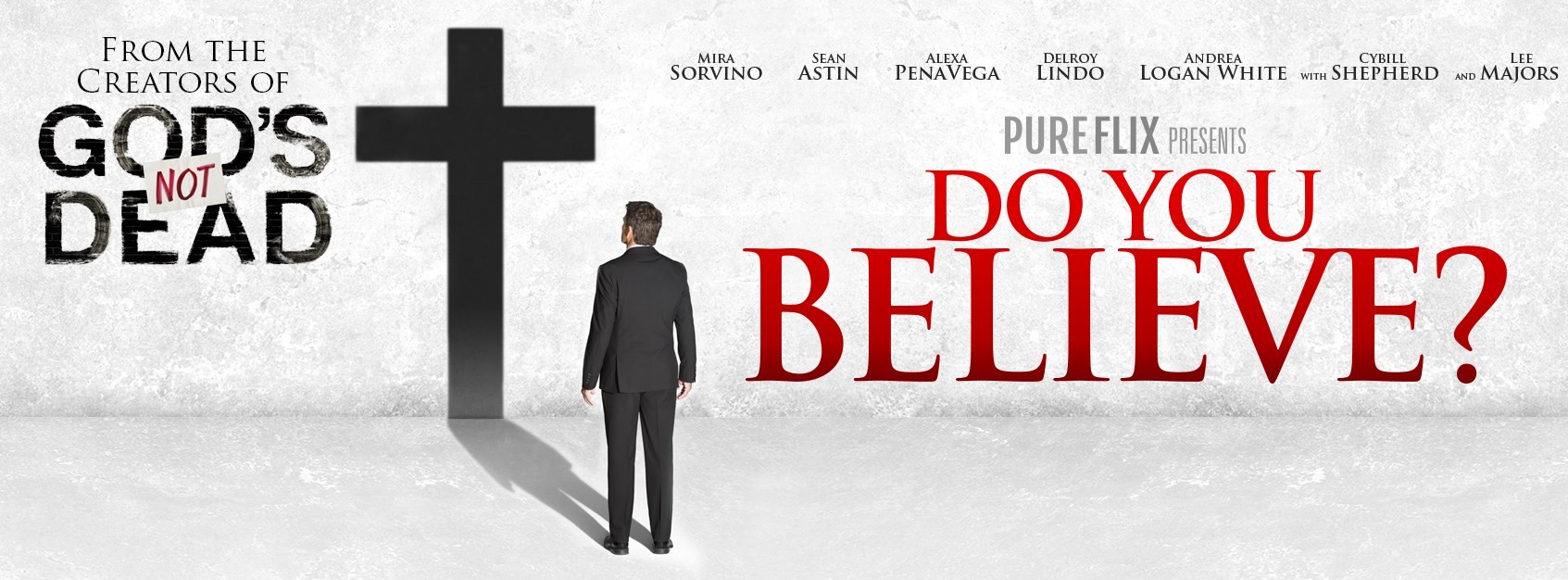
Do-You-Believe

Do You Believe?, which was created by the same people who made God’s Not Dead, tells the story of twelve desperate characters whose lives will inevitably intertwine as they come to see the power of the Cross.
I have no idea why this movie wasn’t a hit like God’s Not Dead because this is another genre-saving movie that Christian filmmakers need to imitate.

How many Christian films do you see take on homelessness, self-mutilation, gang violence, PTSD, familial abandonment, loss of a child, teenage pregnancy and other heavy topics in just two hours?  Now while they never get R-rated graphic with the self-cutting or the gang violence, just having those elements in a Christian film is pretty bold.
All of the performances are excellent with every single actor being fully invested in their roles.  There’s a sense that the director and screenwriters (two people wrote this movie) know that this film isn’t going to appeal to everyone, but they’re willing to take that chance so that they can passionately tell the story that they want to tell.  Quite frankly, I can’t help but admire everyone involved with this project.
I was biting my nails because telling multiple storylines is a difficult formula and it has more failures than successes.  However I am delighted to announce that this is a brilliant multiple-character study.   Each storyline is well-developed and the pacing–hallelujah!–the pacing is smooth sailing.  There is never a dull moment because every scene has a rhyme and reason for existing.   The film transitions very well because each story arch ties into another story arch, woven like a quilt of cinematic competence.
Thank you, Lord Jesus, for a Christian film that FINALLY tackles “faith without works is dead.”  That is shockingly rare in Christian movies, so for a film in this genre to acknowledge that belief in Jesus requires action is a much needed breath of fresh air.

Okay, now I’ve praised the film to death, there are some things I have to address.  Like Amelie, this is a niche film.  Atheists will not like this movie because the non-believing characters range from militant jerks (Sean Astin’s doctor character) to vaguely defined semi-atheists (Andrea Logan-White’s lawyer character).  The agnostic characters are more like sort-of agnostic-ish who just need the kindness of a Christian friend in order to convert.  Also some of the dialogue can get preachy and one of the storylines ends with a miracle that kind of comes out of left field.

I remember one of the teens at my LifeTeen youth group telling me that she saw this film in theaters and was blown away by it.  Having watched it, I can see why.  Passion and talent permeate every frame of this film.  Unlike the people who slogged through Fant4stic Four, everyone put their all into this movie and that’s really all I could ask for.

The movie challenges viewers with the question: “If you believe in the power of the Cross, then the question is…what are you gonna do about it?”
Your move; what’s your answer?