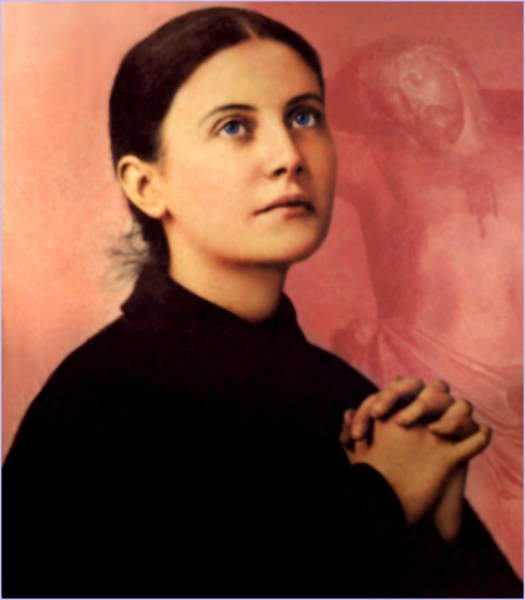
Victim Soul Chapter Three

St_Gemma_Galgani

[Author’s Note: The first artistic liberty taken is that Satan’s words to Gemma, “Do you not see that this Jesus does not hear you, and wants to have no more to do with you.  Give up, and be resigned to your unhappy lot” have been inserted into the opening scene.  My research confirmed that this is one of the many insults hurled at her by the prince of darkness, but when exactly it was said is unknown.  The second artistic liberty is that after Gemma fails to receive Communion, she sees Satan’s silhouette in a dust fog.  This sequence has been created to foreshadow the epilogue of Victim Soul, which involves a stare-down between the two characters].

“Dear Monsignor Volpi, I must I tell you what happened last night.  I never went to bed, because the Devil frightened me with his blasphemies, and I thought he was in the room; I could neither sleep nor pray.”

“AHAHAHAHAHAHAHA!!!!”
Watching the candle’s restless flame, Gemma sits frozen at her desk as the screeching, maniacal laughter of the devil pierces her eardrums.  Her trembling body trapped in a hunched position, her lips are pressed against her folded arms.  Gripping her scapular in her hand, she dares not to look for her adversary.
“Do you not see that this Jesus does not hear you, and wants to have no more to do with you.” 
The darkness infused with his words shake her to her core.  Gemma shuts her eyes, which swell with coming tears.  She slowly turns her head to the crucifix, from where her beloved watches her.  “My Jesus, I know You are with me now,” she whispers.  She takes deep breaths as she struggles to fight the dread and loneliness that threaten to consume her troubled heart.  She jumps when she feels a tug at her hair, but refuses to turn around.
Give up, and be resigned to your unhappy lot!” The devil’s words are a diabolical hiss that seep into her conscience, furthering her fright.  His presence ceases, but the sting of his cruelty settles in her bones.

Fingers of morning light peer through the stained glass windows.  The altar ahead is a blur in her line of vision.  Gemma’s head turns to the stained glass window next to her pew.  She rubs her eyes.  “Wake up, wake up,” she murmurs to herself.  She freezes when she feels a hand on her shoulder.
“Are you all right, Ms. Galgani?” asks a female voice.  As Gemma glances at her shoulder, for a moment she sees not a hand, but dark talons clutching her.
She shakes her head and looks back at her shoulder.  There are no talons, only the hand of a woman with a round face.  ‘Just like mother,’ Gemma bites her lip. “Yes, signora,” she answers with a meek nod.  She switches her gaze to the altar before she can be questioned further.

1885
“Come here, my darling Gemma…”
Seven-year old Gemma sat herself on Mother’s lap.  She rested her head against mother’s sturdy shoulder. 

“I have prayed so much that Jesus would give me a little girl,” Mother stroked Gemma’s hair.  “He has given me this consolation; it is true, but too late.  I am ill…” her mother’s chest rises as she inhales.  Tears begin to swell, making her eyes look like small pools of grief.  “…and I must die.  I must leave you.” Mother gripped Gemma’s tense shoulders, “Oh, if I could only take you with me!  Would you come?” 
“And where are you going?”
“To heaven with Jesus and the angels…”

A single tear escapes from her eyes.  Gemma wipes it away as quickly as it came.
It is time to receive the Eucharist.  Gemma’s face lights up with a peaceful smile.  Standing at the very end of the small line of parishioners, she raises her eyes to the large crucifix, placing her hands over her heart.  She turns her head to the statue of the Blessed Virgin Mary, which stands by the stained glass, shimmering in colorful incandescence.  “Oh, my Heavenly Mother,” she says in an affectionate whisper.
Looking back at Jesus on the crucifix, she lowers her head as an aching sadness begins to overwhelm her.  As she draws nearer to the priest, the sensation of sinking oppresses her.  ‘My sins, my imperfections put Him there…’ “I put Him on that cross…” she closes her eyes, envisioning Mary cradling the mangled body of her Son.
When the Precious Body is held before her eyes, she turns her head away.
As if her body is moving without her, Gemma realizes that she is running out of the church.  Throwing open the doors, she is blinded by the scorching rays of daylight.  She whirls her body back and forth, trying to remember where she is.  A sudden gust of wind kicks a cloud of dust into her face.
“AHAHAHAHAHAHAHAHAHAHAHAHA!!!!”
Rigidity takes hold of her.  Within the fog she sees a dark silhouette.  Time seems to have come to a halt.  For what feels like an eternity, the world consists of a frightened girl and an entity of darkness standing opposite of each other with only a fog of dust dividing them.
Gemma turns her head, then pauses.  Inhaling air and dirt, she slowly looks back and straightens her shoulders.  The silhouette has vanished, but the cackle continues to ring as a faint echo.
Tightening her lips, she holds up her head.  As her racing heart calms and the tremors throughout her body cease, she moves ahead to the church.  She opens the doors and returns to the line.
The minute the Eucharist passes her lips, her heart is kindled with a tender flame that burns as passionately as her love for her King.

Back at home, Gemma carries a bucket filled with water to the house.  Her eyes downcast, she watches her step to avoid spilling.  Her nostrils fill with the crisp air of springtime.  Opening the door, she treads down the hall, where she stops at a portrait of the Sacred Heart.  Closing her eyes, she places her hand over her heart.  “Jesus, make haste, give me the grace to be ever united with You, in such a way that I may never be separated from You!”
There is a whooshing sound, which is followed by what feels like an array of fiery fists striking her shoulder.   Overcome by white hot pain, Gemma collapses to the ground. Though the fearsome rage of the evil one is palpable, she dares not to look and see if he is physically present. When she finally does look up, she sees that the bucket remains intact with the water perfectly still.  She smiles as she lifts her gaze to the Sacred Heart.

Gemma’s letter to Monsignor Volpi verbatim:

“I must I tell you what happened last night.  I never went to bed, because the Devil frightened me with his blasphemies, and I thought he was in the room; I could neither sleep nor pray.  I did not make my meditation, nor pray from 11 am to 12:00.  I went to church, but when the time came I felt I could not go to Holy Communion. I came out of the church and I heard the Devil laughing very loudly. I understood why, went back to church again and received Holy Communion.  Jesus told me had I not conquered that morning I should never have done so…Yesterday morning my aunt asked me to draw a bucket of water; I filled it and bringing it back had to pass before the picture of the Sacred Heart. I saluted Jesus with these words: ‘Jesus, make haste, give me the grace to be ever united with You, in such a way that I may never be separated from You!’  Just after I had said this I felt a series of sharp blows on my shoulder, so that I fell to the ground, but without breaking anything.”
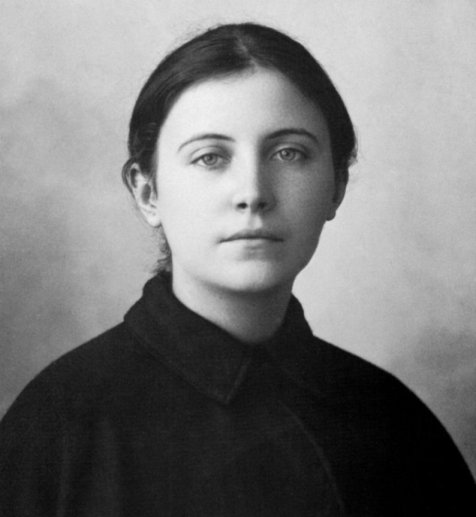
Victim Soul Chapter Two

St-Gemma-closeup-photograph (2)

[Author’s Note: The majority of my research states that Satan started his attacks by giving Gemma violent headaches to keep her from praying.  Just like the scene where Gemma ponders what awaits her in Chapter One, how Satan gives Gemma a migraine is my interpretation of the research I collected.  The artistic liberty I have taken is that while Satan did say to her on occasion, “How stupid you are to think of praying to a criminal. Look at the harm He does you, keeping you nailed to the Cross with Himself. How can you care for one whom you do not even know-who makes all suffer who love Him,” when this was said has not been documented, so I inserted the quote here.  In addition, I portray him attempting to engage her in conversation before triggering her agonizing migraine]. 

Gemma closes her bedroom door.  Undoing her hair, she hurries to the crucifix.  As she begins to kneel, she pauses and looks around the room.  All is calm, the room quiet and still.  Squinting her eyes, she peers at the shadowy corners.  No creature jumps out to grab her, no dark forces surround her.  The only chill in the air comes from the open window. She walks across the room and closes the window.  Within her being, there is no sense of disturbance rattling her soul.  “Maybe it is not time for the devil to harass me yet,” she hopes. She inhales slowly, allowing herself to relax.
Gemma stands in front of the crucifix.  She takes a moment to gaze in awe of Jesus’ purposeful eyes, the crown of thorns on His tilted head.  She places her hand on His nailed feet, its coldness pricks at her fingertips.  Her hand moves and presses to her heart as she contemplates His love, wondrous, sacrificial, everlasting.  Peace and joy consume her at once, which results in a beaming smile across her face.  Making the sign of the cross, she kneels on the floor and closes her eyes, immersing herself in the presence of the Lord.
“I see that you have regained the color in your cheeks…”
Gemma freezes.  The room is suddenly ice-cold, permeated by a dark heaviness in the air.  As her heart races, she keeps her eyes closed and her body kneeled on the floor.
Satan’s footsteps slowly draw near.  His gravelly chuckle send shivers down her spine.“It seems like only yesterday, I was attending to a deathly pale little girl who could barely lift her head as she lie on this very bed.” The condescension in his voice stings her, but she does not move.  She hears him take a seat on her bed.  “Now here you are; a healthy young lady kneeling on a wooden floor, praying to a person you have never seen.” Only the sound of her pounding heartbeat fills the deafening silence between them.  “It is rude to ignore a guest, little one.”
Don’t look at him, don’t look at him, Do. Not. Look…” says her conscience in a panicked whisper.  She raises her head and opens her eyes, the crucifix looming large in her tunnel vision.
In a clear, candid voice, she states, “Jesus is my guest, not you.” She closes her eyes and keeps her head downcast, bracing herself for whatever was to come.
There is a deep growl, followed by silence.  She hears Satan approach her side. “How is your head feeling, Gemma?” he asks.
Gemma feels a quick tap between her eyes.
A searing pain spreads inside her head like a cancerous tumor.  She lets out a visceral cry as her body hits the floor.  She clutches onto her forehead, which burns with white-hot intensity.  In spite of her agony, she is determined to keep her eyes closed.  ‘I will not allow his image to enter my mind,’ she vows internally.
“Oh, dear, you look very uncomfortable.  Why don’t you lay down?  That might help your poor head.”
Gemma feels his talons press down on her head, which makes the splitting pain even more excruciating.  She slightly opens her watering eyes to look up at the crucifix.
Satan releases her head, but the torturous migraine continues.  Gemma raises her body the best she can.
“It is almost midnight, child.  There is no shame in climbing into bed, closing your eyes and resting the headache away,” he taunts.
Even in her torment, Gemma mentally conjures the image of Jesus in her mind’s eye.  She crawls closer to the crucifix and grips her hands in prayer.  She anticipates what must surely come next: Blood trickling down from her throbbing head.
Satan’s howling laughter rings in her ears, “How stupid you are to think of praying to a criminal. Look at the harm He does you, keeping you nailed to the Cross with Himself. How can you care for one whom you do not even know-who makes all suffer who love Him?
In that moment, Gemma feels His presence.   It is a soft warmth that envelopes her.  As the furious migraine ceases, an enraged scream shakes the room.  All at once, both the warmth and the dark presence of the devil disappear.
Slowly rising from the floor, Gemma faces the crucifix and, with a gracious smile, whispers a relieved, “Thank you, my Jesus.  Thank you.”

Victim Soul Chapter One

Santa-Gema-Galgani-8

[Author’s Note: Some artistic liberties have been taken.  Gemma’s letter to Father Germano is verbatim, but because we do not know anything about the night before the devil began his Hellish campaign against her, the opening scene is my interpretation of how Gemma would come to terms with what awaits her.  The flashback to 1899 is also accurate with two exceptions.  Satan did offer to cure her, but what exactly was said was not documented.  Also, Gemma called out to then-Venerable Gabriel Possenti twice, but in the flashback, I shortened it for the sake of brevity].

“Jesus, make haste, give me the grace to be ever united with You, in such a way that I may never be separated from You.”
–Saint Gemma Galgani

Lucca, Italy – 1902

“Dear Father Germano…”

Her pen gripped in her trembling hand, Gemma Galgani begins her letter.

“During the last two days Jesus has been telling me after Holy Communion: ‘My daughter, the devil will soon wage a great war against you.’”

She pauses, lifting her eyes to the dancing firelight of her candle.  She rests her jaw in the palm of her hand, listening to her own increasing heartbeat.  After a moment, she resumes writing:

“These words I hear in my heart continuously.  Please pray for me….”

A sudden chill overcomes the room.  Gemma rises from the small table.  She wraps herself in her black mantellette robe.  The cold persists, but the fabric of the mantellette keeps in the warmth.  She sits herself down and presses on with her letter:

“Who will win this battle: the devil or my soul?  How sad this thing makes me!  Where will the war come from?  I am for ever thinking about it instead of praying Jesus to give me strength and help.  Now I have told you, and I leave this matter to you, that you may help me.

Your poor,

Gemma.”

The pitch blackness of nightfall makes her window look like a square hole into an unknown abyss.  Gemma stands up and walks to the window, focusing her eyes on the scattered stars.  She leans forward and rests her arms on the window frame.  Ashen clouds curtain the full moon, engulfing the stars.
Her head lowers, “Jesus, am I truly ready for this coming trial?” She places her hand on her forehead as anxiety races through her mind.  “What if–” she hunches forward, crossing her arms.  “What if the devil overcomes me?” As her eyes swell with coming tears, she looks at her bed.  “To think that I almost gave in…” she closes her eyes as the memory of her weakest moment overwhelms her, a seemingly ancient time when illness had crippled her and made her susceptible to the darkest temptation.

1899
“My, my, you poor thing…” a wicked voice echoed from the shadows of her room.
Gemma sat up, turning her head as her weary eyes scanned the room.  “Who…who is th-there?” Succumbing to the pain in her spine, she lay back down.
“Tsk tsk tsk, to say that you are not looking well would be an understatement, now wouldn’t it?” The dark figure took form.  Gemma forced her eyes open and stared at the being, a muscular angel with folded wings and small horns.  His skin and talons the color of shadows, his fiery eyes bore into hers.
Gemma couldn’t stop her body from shaking.  “You–you’re…Lucifer.”  Her blood froze at the sound of his laughter.  “Ah, I haven’t heard that name in a long time,”  Satan reached out his hand to touch her forehead.  Gemma turned her head away.  Were it not for her afflicted spine, she would have turned her back to him.
“I mean you no harm, dear child.  Quite the contrary,” Satan wandered around her room.  Relaxing her body, Gemma watched him cringe at the crucifix on her wall.  She looked away when he faced her.
“Ignoring me is not going to make me disappear, little one,” Satan narrowed his eyebrows, staring her down the way a lion faces its weakened prey.  He paced back and forth, “As a fallen angel, I may not be on good terms with your friend,” he pointed at the crucifix, “…but I still have all kinds of powers.  If you were to give me a chance, I could cure you.”
Beads of sweat drenched her forehead and ran down her deathly pale face.  Clutching onto the sheets, Gemma grinded her teeth as she endured the terrible pain.  Her eyes watered as her vision blurred from the pounding migraine.
Satan’s mouth lifted into a sinister grin, “I can take away your suffering, Gemma.  Whatever you desire, I will grant you.  If you submit to me, obey me, do as I say, I will see to it that your body never betrays you again.”  He opened his palm and reached out to her.  “Just take my hand and I will free you from your misery.”
Gemma kept her eyes on the ceiling.  Desperation began to drown her.  As if her body was moving without her consent, her hand lifted.  She pulled back, clenching her fist.  She relaxed her hand, leaving it mid-air.
At that moment, a face appeared before her mind’s eye. 
St_Gabriel_Possenti_CP

Venerable Gabriel Possenti…the holy boy she had read about.  His figure covered in light, his soft brown eyes gazed into hers.  For a moment, she forgot that the prince of darkness was standing at the foot of her bed.
Gemma inhaled through her nostrils.  With a cold-stone expression on her face, she realized that she was at a crossroads and only one path could be chosen.
A guttural cry escaped from her, “Venerable Gabriel, save my soul first and then my body!”  With that hand that almost ended up in Satan’s grasp, she made the sign of the cross as fast as she could.
There was a flash of light, followed by a furious scream.  When the light disappeared, so had the enemy.

Gemma raises her eyebrow.  “Hmm, how odd, I don’t remember blowing out the candle…” she looks curiously at the extinguished candle.  The frail line of smoke disappears into the air as it floats from the charred wick.
She gasps as she looks around the darkened room.  She takes a deep breath to calm her nerves.  “All right, if this is what You want, Jesus…” she pauses, staring straight into the shadow that has engulfed her door.  “…then I want it, too.  So long as You give me the strength to stand my ground against him.”
Gemma curls up on her bed.  Weariness presses down on her, pushing her into a deep slumber.  The last thing she sees is a shadowy figure standing by the window.

Strong, Brave Bear: Saint Bernadette Soubirous

Given that I love all things Saints, I collect various items such as Saints cards and statues.  The item that started my Saint collecting hobby was my statue of Saint Bernadette.

12804614_1113836068649920_8629422350780319039_n (2)


I have had this statue since I was a baby.  I became anemic shortly after I was born, so along with being given iron drops, my feisty and faith-filled Grandma Joanie handed my mother the Saint Bernadette statue and said, “Put this above her crib and ask Bernadette to pray for her.”  My mother did just that and asked Saint Bernadette, who suffered from poor health her whole life, to pray for my health as a baby.
As I was preparing to write this bio on Bernadette, a blood vessel broke in my left eye, so like my mother and grandmother had, I asked Saint Bernadette to pray for the healing of my eye.
The red spot in my eye disappeared by the time I started writing this piece.
I like to think that this post is my way of repaying the holy girl who has prayed for me in the past and in the present.
This is the story of Saint Bernadette Soubirous!
Saint-Bernadette

On January 7th, 1844, a baby girl was born to a miller named François Soubirous and his wife Louise.  Gazing into the eyes of their first child, they gave her the name Marie-Bernarde.  She was known by her nickname “Bernadette,” which means “strong, brave bear.”  The troubled early years that awaited her would require her to be strong and brave.
After enjoying years of comfort and prosperity, a series of misfortunes had befallen the Soubirous family.  Francois and Louise had eight more children after Bernadette; four of whom died shortly after entering the world.  Enduring the pain of losing brothers and sisters was just one of many crosses the young girl had to bear.  Then, like Jean Valjean, Francois Soubirous was arrested on suspicion of stealing a single wood plank.  He was later released without being charged, but his initial arrest was a huge blow to the Soubirous family’s social reputation and their bank account.  By 1858, the financial situation of the Soubirous family was so desperate that they had to live in an old jail called le cachot, or “the dungeon.”
To call Bernadette sickly would be an understatement.   As a toddler, she was hit with cholera and barely survived.  Due to the dampness of le cachot, she suffered from asthma her entire life.  To add insult to injury, at the age of 14, she was studying basic catechism in a room full of seven-year olds.

February 11th, 1858 started off like any other day.  Bernadette, her sister Marie and a friend of theirs were collecting firewood.  I think I’ll let Bernadette tell us what she saw:

I came back towards the grotto and started taking off my stockings. I had hardly taken off the first stocking when I heard a sound like a gust of wind. Then I turned my head towards the meadow. I saw the trees quite still: I went on taking off my stockings. I heard the same sound again. As I raised my head to look at the grotto, I saw a Lady dressed in white, wearing a white dress, a blue girdle and a yellow rose on each foot, the same color as the chain of her rosary; the beads of the rosary were white.”

Like any teenager would, Bernadette went home and told her friends, who in turn talked to her parents about what she had said.  Francois and Louise were understandingly disturbed and forbade Bernadette from going back to the grotto.  Bernadette respected their wishes and stayed away from the grotto.  However, she felt compelled to return to the place where she had seen what she called “Aquero,” which means “that” in Occitan, the language of her region.
After Sunday Mass on February 14th, Bernadette, Marie and a few other girls headed back to the grotto, where Bernadette saw Aquero again.  She knelt to the ground immediately and fell into a trance.  Clutching a bottle of holy water in her hands, she thrust holy water in Aquero’s direction.  ‘If it’s a demon, it’ll flee,’ she thought.
Aquero simply smiled.
Bernadette returned home with her sister with the resolve to visit the grotto once more.
On February 18th, seven days later, Bernadette ventured to the grotto.  She had to know.  She had to see for herself whether this mysterious figure was true or nothing more than a figment of her imagination.   Standing in front of the grotto, her focused eyes waited for the Lady.   Within minutes, Aquero was there.  The peasant girl stared in awe of the shimmering woman.  It was then that the Lady spoke.  She requested that Bernadette return to the grotto every day for a fortnight.

“She could not promise to make me happy in this world, only in the next.”

From there, rumors of Bernadette’s vision made way through the small town.  It started when her sister spread word to her friends, who then passed it on to their parents; think of it as the 18th century version of the telephone game.  Before she knew it, Bernadette had become a controversial figure in Lourdes.  In one corner, she had her supporters who swore, “This child is a visionary!  A prophet!”  In another corner were her detractors who declared, “She is mentally ill!  She must be sent away!”  That an impoverished girl who couldn’t even spell her own name had been visited by a messenger from God was an outrageous notion.   To put this into perspective, imagine if Bernadette was a teenage girl living today in our social media age.  You know that little corner of your newsfeed where it says “TRENDING“?  If the Lourdes apparitions were happening now, you would see “Bernadette Soubirous” right underneath “TRENDING” every single day.
Before she knew it, her name and story had made it to the ears of county government officials…

February 21st, 1858
“Come in, Ms. Soubirous,”
Bernadette’s trembling hand twisted the knob.  Pushing open the door, she saw Commissioner Dominique Jacomet.  Tall and well-dressed, the professional man of the law stared down at the simple girl, who stood cloaked in an array of patched fabric.  Shaken but resolute, Bernadette sat across from Jacomet, ready for the questions that were sure to come her way.
JACOMET: (Prepares notes) “Did you see something Ugly?”
BERNADETTE: (Shakes head) “Oh, no! I saw a beautiful young girl with a rosary on her arm.”
JACOMET: (Raises eyebrow) “Well, now, Bernadette, you saw the Blessed Virgin?”
BERNADETTE: (Looks with confusion) “I never said I saw the Blessed Virgin.”
JACOMET: (Smiles) (Points at BERNADETTE) “Ah, well!  You say nothing!”
BERNADETTE(Knuckles tighten) (Gives insistent nod) “Yes, I saw something.”
JACOMET: “Well, what did you see?”
BERNADETTE: “Something white.”
JACOMET: “Was it some thing, or some one?”
BERNADETTE: “Aquero has the form of a young girl.”
JACOMET: “And Aquero did not say “I am the Blessed Virgin”?”
BERNADETTE: “Aquero did not say that to me.”
JACOMET: “All right then, this lady..er. this girl, she wears clothes?”
BERNADETTE: “A white dress, with a blue sash, a white veil on her head and a yellow rose on each foot… and rosary beads in her hands.”
JACOMET: “Is she Beautiful?”
BERNADETTE: “Oh, yes sir, very beautiful.”
JACOMET: “As beautiful as who? Madame Pailhasson?”
BERNADETTE: (Chuckles sweetly) “They don’t even come close.”
JACOMET: “How old is she?”
BERNADETTE: “Young.” (Pauses) “But sir, I saw Aquero a number of times. I can’t still be mistaken.  I can’t explain it, but I’m sure I saw something.”
JACOMET: (Rises from his chair) “Listen, Bernadette, everybody’s laughing at you. Everyone says you are mistaken, that you’re crazy.  For your own good, you must not go back to that grotto!”
BERNADETTE: (Locks eyes with JACOMET)“I promised to go for fifteen days.”

It had been during the third apparition when Aquero said in Bernadette’s native Occitan, “Boulet aoue ra gracia de bié aci penden quinze dias?”  In English, this translates to, “Would you have the goodness to come here for fifteen days?” Even when confronted by Jacomet, Bernadette stood by her promise.
The apparitions that started on February 11th continued until July 16th in 1858.  Bernadette never missed a day.  With each day, the grotto became the place to be.  People gathered to watch Bernadette’s interactions with the mystery Lady.  During one of her encounters, Bernadette was asked by Aquero to go drink at the fountain and wash herself.  There was just one problem: There was no fountain, only a Gave (a hollow corner).  Bernadette began to dig, muddying her hands until she finally came across water.  A few days later, the spring began to flow from the Gave.
Aquero’s next task for Bernadette was to go to the priests and tell them to go in procession to the grotto and build a chapel there.
Bernadette turned to Father Dominique Peyramale, who dismissed her and ordered her to not return to the grotto.  She remained persistent and began pestering other priests about Aquero’s request.  With a grudging respect for the girl’s determination, Father Peyramale spoke with her again.  “No chapel is being built until we know the woman’s name,” he explained sharply.
Any time Bernadette would ask Aquero for her name, the Lady would respond with a smile.  It wasn’t until March 25th when Bernadette pressed Aquero with a little more force for her name.
Aquero stopped smiling.  Lowering her arms, her radiant eyes raised to Heaven.  She folded her arms over her breasts and spoke.
Bernadette’s eyes widened.  A gasp escaped her lips.  Within her racing heart, she felt the light of clarity.  Rising to her feet, she stood struck by the realization that she was a part of something greater, a grand plan that surpassed her finite understanding.
Holding her rosary close to her heart, Bernadette turned to the crowd, “I am the Immaculate Conception.”  That is what Aquero, the Blessed Virgin Mary, had said to her.
Shaken by this revelation, Father Peyramale, now a believer in Bernadette’s experience, made a trip to visit the bishop, who forbade him from going to the grotto.

The final apparition occurred on July 16th.  The Virgin Mary greeted Bernadette with a motherly gaze.

“All I saw was Our Lady.  She was more beautiful than ever.”

Bernadette disliked all the attention she had garnered, so she attended a hospice school run by the Sisters of Charity of Nevers.  It was here that she finally learned how to write and read (even how to spell her own name!)  Discovering that her true vocation was the religious life, Bernadette set her sights on the Carmelites, but her poor health made her ineligible for stricter orders.  On July 29, 1866, Bernadette was one of 42 women to take the religious habit of postulant and join the Sisters of Charity.  The Mother Superior bestowed upon her the name, “Sister Marie-Bernarde.”
Bernadette’s remaining years were spent as an infirmary assistant, then later a sacristan.  Sadly, she had to endure ridicule from other sisters who were skeptical about her apparitions.  She was given harsher discipline, for the Mother Superior wanted to prevent her from becoming prideful.  Having been obedient to the Virgin Mary, Bernadette held up her head and did exactly as she was told.
Bernadette’s health was struck by tuberculosis in the bone of her right knee.  She did as much work as she could until the tuberculosis made her unable to go on any longer.   On April 16, 1879, 35-year old Bernadette Soubirous lay on her deathbed, suffering terribly from the pain.  With her last breath, Bernadette prayed aloud her final words:

“Blessed Mary, Mother of God, pray for me!  A poor sinner, a poor sinner!”

Have you been researching someone’s life and the more you learn, the more you come to love them?  As Saint Lucy and Saint Agnes are my sisters, so too is Bernadette.  I am in awe of her humility and bravery to stand alone in her convictions, which is a rarity in modern society.  She never caved to the pressure to change her story or stay away from the grotto.   It is no coincidence, it was part of God’s plan, that her name means “strong, brave bear.”

Saint Bernadette Soubirous, pray for us.

CGB Reflections: What It Means To Stand Alone

10206819505_03c7027a1a

It is nice to be surrounded by likeminded people.  As human beings, it is natural for us to desire being around those who think like we do.  There’s nothing wrong with that.  God placed in our hearts a need for community so that we would not live in isolation.

However, we also come across people who we respect, but don’t agree with.  In this case, we have two options: Disassociate with them and remain in our own echo chamber or put aside political differences and welcome each other’s friendship.

Now let’s go even further.  What happens when you discover that your closest friend of many years is on the other side of an issue you deeply care about?  What if the majority of your co-workers support a proposed piece of legislation that you oppose or vice versa?
What if, on a hot-button issue, you don’t see eye to eye with a relative or maybe even with your entire family?

There will come a time in your life where you will be confronted with two options: Become a member of the tide or stand alone as a master of your convictions.  Believe me, it is a very difficult decision.   To disagree with the people in your life is not a rejection of them.  Rather it is a test of how you will handle times of controversy and opposition.  Unfortunately, people will misunderstand you.  Our society is so divided that disagreement is often perceived as a personal attack.  You may be shunned at work, lose a friend, or have your loyalty questioned by your family; these are the realities of going against the grain.

God tests us in this way to see whether we are ruled by fear or courage.  He wants to see if we will go along with the opinions of others for the sake of keeping the peace or if we will be bold enough to follow our conscience when it contradicts the conventional narrative.  He places these challenges in our lives to know if He can count on us to stand up for His Word, even if it means being a lone advocate.

We are all pilgrims passing through this life.  Our souls were made for Heaven, not earth.  At the end of our lives, we will stand before God.  You will face Him and so will I.   He will have many questions for us; one of those questions will be this:

“Did you stand with the world or did you stand with Me?”

What will your answer be?

“Do not think that I have come to bring peace upon the earth. I have come to bring not peace but the sword. For I have come to set a man against his father, a daughter against her mother, and a daughter-in-law against her mother-in-law; and one’s enemies will be those of his household.”
–Matthew 10:34-36

“There comes a time when one must take a position that is neither safe, nor politic, nor popular, but he must take it because conscience tells him it is right.”
―Dr. Martin Luther King Jr.

Saint Bernadette Soubirous, pray for us.


Equals, Not Enemies: How Men and Women Complement One Another

original

It has occurred to me that there is a hostility between men and women these days.  In one corner, you have self-proclaimed feminists who reject their body’s ability to carry life and view men as either cheating oppressors or dimwitted and lazy.
In another corner, an underground generation of disgruntled men who loathe the advancements of women in modern society and believe that women should be submissive sex objects (I’m looking at you, Return of Kings) has formed.
Both of these mindsets show that our seemingly “progressive” society has not advanced in teaching boys and girls how to relate to one another.

As a millennial woman, I feel the need to say that men should not dominate over women and women should not dominate over men. Neither of the sexes should compete for superiority over one another.  Both men and women are human beings deserving of dignity and equality. Masculinity and femininity are beautiful and are unique in their own way.  Both genders have different roles to play.  No, I’m not talking about stock gender roles imposed by society.  Actually, by “different roles,” I’m talking about something much deeper and beyond the surface.
In the words of Venerable Archbishop Fulton J. Sheen, “A man may stand for the justice of God, but a woman stands for His Mercy.” Now this quote does not mean that “men are strong and women are weak.” Quite the contrary, my friends.  Let’s take a look.

Interpreting the first part of the quote, “A man may stand for the justice of God,” we see that men do have a natural inclination to protect. It’s just something that lies within the heart of men. Ask any man who is a husband, boyfriend, father, brother or uncle. Their first instinct is to protect the important women of their lives (wives, girlfriends, daughters, sisters, nieces, etc.)  Saint Pope John Paul II once said, “It is the duty of every man to uphold the dignity of every woman.” Now there are men in our world who commit horrendous acts against women, there’s no denying that. However acting against your true nature does not make the natural inclination disappear. The exception does not change or invalidate the rule. Men are called to uphold and protect the human dignity of women and when a man objectifies a woman, he is acting against justice and violating his true nature.

Interpreting the second part of the quote, “but a woman stands for His mercy,” we must first address that mercy does not mean weakness or subservience. Mercy is compassion and tenderness. Ever wonder why many women (not all women, but a good number of women) are more likely to show leniency towards someone who makes a dumb mistake than men are?  It’s because there’s something within the feminine heart that leans towards mercy. With mercy comes nurturing and we should note that it is not sexist to say that within the heart of every woman is the inclination to nurture. Again, nurturing is not a suggestion of weakness. In fact, one of the definitions of nurture is “to feed and protect” (You can check it out here if you are so inclined http://dictionary.reference.com/browse/nurture). Within the nurturing inclination is to protect, so women are also called to protect the people of their lives, which includes the men.  Just as men are tasked with defending the dignity of women, women are also tasked to uphold the dignity of men.

The men and women of today need to rise above this “us vs. them” mentality. Both of the sexes must build one another up instead of tearing each other down.  Men and women are called to affirm and uphold one another.  When men and women work together for the sake of human dignity, this is how peace will be achieved.

Saint Benedict and Saint Scholastica, pray for us.

A Lamb Among Lions: Saint Agnes of Rome

Saint Agnes holds a special place in my heart.  She was the first Saint I ever learned about.
As a little girl, I remember being inspired by her strength and faith in Jesus.  Whenever a teacher asked me what I wanted to be when I grew up, I would reply, “I want to be like Saint Agnes.” As you can imagine, the response was usually a polite smile from the teacher and snickering from my classmates.
As a teenager, when it came time for me to pick a Confirmation Saint, Agnes was my very first choice.  Granted, the winner was Saint Monica, but I still consider Agnes to be my spiritual sister.  Honestly, if it weren’t for her, I probably wouldn’t have a devotion to the Saints in the first place.
Without further ado, I’d like to introduce you to my spiritual sister, Agnes of Rome.

8bc38818b3523be0b93fd06a07c3b438

In 291 AD, a Christian family of Roman nobility was blessed with a beautiful baby girl.  The child was named Agnes, which comes from the Latin agnus, meaning “lamb.”
Little is known about Agnes’ childhood, but what we do know is that she was very beautiful.  It has been said that she was graced with a cascade of silky hair that draped over her shoulders like a shawl and a tender smile.  By the time she was twelve, she already had a good amount of high-ranking men competing for her hand in marriage.
However, when she was approached by a potential suitor, her answer was always, “Jesus Christ is my only Spouse.”

As a child raised in a devout household, Agnes had come to know Jesus as her Savior.  In an era where daughters were married off for advantage and power, Agnes made a countercultural choice: She claimed Christ as her spouse.  Her body, mind and soul belonged to the One who created her.
Her commitment to Jesus did not go over well with the men who wanted her.  For example, a man named Procop saw Agnes’ purity as a challenge for him to conquer.  He showered her with flowers, jewels and the finest clothes.  He filled her ears with promises of power, wealth and pleasure.
Agnes fought back with this defense, “I am already promised to the Lord of the Universe. He is more splendid than the sun and the stars, and He has said He will never leave me!” Her body belonged to no man; only God.

Another rejected suitor was the son of Prefect Sempronius.  The Prefect himself tried to persuade Agnes to accept his son’s hand in marriage.  As expected, Agnes kept her eyes on Heaven and turned away from the prospect of earthly matrimony.
It is unclear who ratted her out to the authorities.  Some have guessed it to have been Procop, others say that Prefect Sempronius himself was the catalyst of Agnes’ demise.  What we do know for sure is that Agnes was arrested for professing Christianity.

Agnes was ordered to pray to the Pagan gods in exchange for her freedom.  Filled with resolve, she stayed faithful to her Spouse and refused to worship any other god.  The brave twelve-year old was thrown into a brothel to be violated.  When the men attempted to have their way with her, Agnes’ hair grew to an exponential length and shielded her body.  Within minutes, their lustful eyes were struck blind.  Some accounts have claimed that among the would-be rapists was Prefect Sempronius’ son and that Agnes healed him with a prayer.
The next trial Agnes faced was being stripped naked and burned at the stake.  Just like in the brothel, Agnes’ Rapunzel-esque hair cloaked her body.  Then when the soldiers tried to ignite the flames, the wood surrounding her wouldn’t burn.  This miracle shocked the onlookers and the sympathy of the citizens turned to Agnes.
It was a sword to the throat that brought an end to Agnes’ life.

In our modern world, people use “choice” as a buzzword for expediency.  Agnes, whose expedient choice would have been to give in to societal expectation, chose the more difficult path, one that led to great suffering and to Eternal Life.  In many respects, Agnes was a woman ahead of her time.

Saint Agnes of Rome, pray for us.

What We Stand For: A Brief Reflection on The Colorado Springs Planned Parenthood Shooting

newborn-3

I’m sure by now you have heard of the Planned Parenthod shooting that took place in Colorado Springs yesterday.  However, just for emphasis, I will summarize it:
At 11:38 local time, 57-year old Robert Lewis Dear burst into the Planned Parenthood clinic in Colorado Springs and opened fire. The staff and patients took cover in closets and bathrooms.
Police were engaged in a standoff with Robert Lewis Dear that some sources say lasted five hours while other sources state lasted for six hours. Officers continued to encounter gunfire as they evacuated the people who had taken cover.
The standoff ended when Robert Lewis Dear surrendered.

Since yesterday I have been taking to Facebook and joining the flood of pro-life groups and advocates who have been condemning Robert Lewis Dear’s act of violence against Planned Parenthood.  However, that hasn’t stop detractors from using this tragedy to blame pro-life activists and smear our cause.  For me, the biggest blow came when Buzzfeed posted an article entitled, “Some Abortion Foes Cheered the Planned Parenthood Shooting.”  http://www.buzzfeed.com/rachelzarrell/some-pro-life-supporters-cheered-planned-parenthood-shooting?utm_term=.uoAz1YPPe#.ggM0eMww9

After that, I just logged off and took some time to take a breath.  My heart was already heavy from what happened in Colorado Springs, and to see a cause I care for being slandered was even worse.
I went to our living room and sat in front of the Christmas tree, staring at the ornaments and lights.  “Why should I even bother?” I asked myself. Why should I even bother to keep posting about how pro-life groups have condemned what happened in Colorado Springs if people will continue to paint us as violent extremists anyway?
I looked at our pictures of Jesus and Mary that hang side by side on our wall. I bore my eyes into Jesus’ image, concentrating at his upward gaze, his purposeful expression.

Then, somehow, I came to a distressing thought: ‘Why did Jesus even bother to die on the Cross?’

I had to sit down.  Jesus died for our sins, but we still sin anyway, so why would He bother?
The answer: Because Jesus’ mission was to save us.

This conclusion lifted me from my drained state.  Why should I bother to be vocal about defending the pro-life cause?
Because defending every life is our mission.

What others say about us doesn’t matter.  How society paints us is irrelevant.  Pro-life does not exist to please others.  Pro-life exists to protect the dignity of every single life.

Pro-life means defending the humanity of the unborn baby.
Pro-life means reaching out to the single mother.
Pro-life means offering hope to the pregnant teenager.
Pro-life means supporting the rape victim.
Pro-life means showing mercy to abortion clinic workers.
Pro-life means feeding and clothing the homeless.
Pro-life means welcoming the refugee.
Pro-life means standing up for the death row inmate.
Pro-life means giving shelter to abandoned animals.
Pro-life means every beating heart matters.
I will say this as many times as I need to: Pro-life does not stand for violence or extremism.  We do not stand for shaming women or abortion workers.  You cannot call yourself pro-life if you do not condemn violence against clinics or the people who work there.  Oppose abortion, but do no harm to those who support it.

Pro-life is pro-peace.
Period.


A Mother’s Love: Saint Monica

I was sixteen-years old when I was going through the Confirmation program. When it came time for me to pick a saint, I was torn between all the single saintly ladies: Teresa of Avila and Catherine of Siena were my top picks, but so were Agnes of Rome, Maria Goretti, and Cecilia.  Joan of Arc is cool, but Lucy of Syracuse is like a sister to me.  Then there’s my parish patron Kateri Tekakwitha to consider, but then again, Faustina Kowalska is the patroness of the Divine Mercy!  AAAAHHHHH!!!!
As you can see, I was quite stressed.  So many awesome ladies to choose from and I only had so much time.  I remember flipping through my Saints book in a panic.  I ended up dropping it and watched it cracked open on the tile.  When I picked it up, I saw the page on Saint Monica.
I skimmed through her chapter, “She doesn’t seem very interesting.”  She wasn’t a soldier like Joan or a martyr like Lucy, Maria or Agnes.  I put Monica on the backburner for a while.
However, the longer I resisted, the more she crept up on me.  One night I went online and read up on Monica.  I scratched my head, “God, why should I pick her?  We have nothing in common.”
At first glance, Monica and I were incompatible as candidate and patron.
She was a married woman.  I am single.
She lived in Africa.  I am a born-and-raised California girl.
She was an obedient old woman.  I am a headstrong young woman.
In spite of all these differences between us, I couldn’t bring myself to click out of her info page just yet.  So I sighed and took a second look at her story.

Saint Monica portrayed by actress Monica Guerritore in Restless Heart.

Saint Monica was born in 331 AD in Tagaste, which is now known as Souk Ahras, Algeria.  Not much is known about Monica’s childhood, but we do know that she was born after Constantine legalized Christianity.
You may have noticed that in a lot of my Saints bios, many of these guys and gals were either in arranged marriages (ex. Cecilia) or were arranged to be married to somebody (ex. Lucy).  Monica is no exception.
She was twenty-two (a year younger than me) when she was betrothed to a Pagan man named Patricius.  By all accounts, Monica was a generous and obedient girl, so she was married off without hesitation.
To put it simply, Monica got a pretty raw deal because Patricius was the biggest jerk in Tagaste.  Violent, with an explosive temper, he verbally and physically abused Monica during his outbursts.  To add insult to injury, he was the kind of guy who would be a regular Ashley Madison customer if he lived in the year 2015.  Oh, and did I mention that his mother/Monica’s mother-in-law also worse than Nurse Ratchet from “One Flew Over the Cuckoo’s Nest?”  Needless to say, the apple didn’t fall far from the tree.
Now, you’re probably thinking, “Ditch this guy, Monica,” but divorce court wasn’t a thing in AD Tagaste.  These were the days where a man could leave his wife if she wasn’t a virgin, but a woman was stuck with a hot-headed cheater.
Monica was a Christian and she was especially drawn to Christianity’s emphasis on kindness and humility.  She was also very smart, so she figured that if she couldn’t leave Patricius, she would kill him with kindness.  She knew she couldn’t fight back when he hit her because she would end up on the streets as a beggar woman, so she said her prayers aloud, ignoring him as he stormed off.   When he came home after visiting one of his “lady friends,” Patricius scratched his head when he saw a lavish meal prepared for him by the wife he was betraying.
Monica’s charitible approach won over Patricius’ respect and admiration, to where his punches became less frequent and he began walking out of the room instead of screaming at her.

Monica had three children with Patricius; Augustine, Navigius and Perpetua. There’s very little info on Navigius and Perpetua (I did find out that Navigius entered the monastery), but Augustine–oh, yes–there is a plethora of info on Augustine.  Why?  Because her Augustine just so happens to be THE great Saint Augustine of Hippo.  What a twist!
Monica did the best job she could at raising her children in the faith, but remember, Patricius was an aggressive Pagan and it was his way or the highway. Augustine was the oldest son and it’s not uncommon for the oldest son to gravitate towards his father.  This means that Augustine was very much his father’s son in his actions…and in his beliefs.
Monica knew that her son was a fast-learner, but her heart broke when she saw how disinterested he was in her Christian faith.  She was even more distressed when she realized that Paganism was more enticing to her impressionable son.

After years of being bound to his sinful ways, Patricius converted to Christianity on his deathbed.  However, Monica still had one more thing to do: Save her Pagan-party boy son!  (Plays Superman theme music)
When Augustine grew up, he traveled to Carthage.  In those days, saying “I’m going to Carthage” was like saying, “I’m going to Harvard.”  It was where all the great thinkers went to, well, think and trade abstract ideas.  It was also where many heresies and questionable theological theories sprang up and resided.  These ideas influenced Augustine and led him astray for oh-so-many years.  To his chagrin, Augustine wasn’t alone.  Right behind him on the boat to Carthage was his mother.

As she followed him on his travels, Monica witnessed Augustine’s sinful ways.  She watched him drink himself into a stupor on multiple occasions.  She watched him blaspheme against God and the Church.  She watched him impregnate a woman he wasn’t married to.  She watched him abandon the woman and their infant son.  Her heart broke with each sin.  Every day she offered up her son in prayer.  She asked God to forgive Augustine and to change his hardened heart.  Sometimes her prayers were calm and contemplative; other times they were shouted in desperation and anger. Every prayer came with tears for her wayward son.  Monica’s valiant praying caught the attention of Saint Ambrose, the bishop of Milan.  Monica went to him and poured out her story about the abuse she suffered and of her fear for Augustine’s immortal soul.  Ambrose was so moved by Monica’s courage and all that she had sacrificed that he assured her, “It is not possible that the child of so many tears should perish.”

Monica’s prayers finally paid off.  Augustine had a powerful “come-to-Jesus” experience that changed his life.  He abandoned his selfish ways and became a Christian.  Monica could live in peace at last.  She was called home to Heaven shortly after.

How Do You Solve a Problem like Cecilia?: Saint Cecilia

This Saints post exists because I owe Saint Cecilia a favor.  First, here’s some backstory:
Last weekend, I was on a LifeTeen retreat (not as a teen, of course.  I’m a Core member).  On Friday my throat felt scratchy and by “lights out” time, my voice was heading down the drain.  All day Saturday, I had a raspy, chain-smoker voice and it hurt to talk.  As luck would have it, I had to give a teaching on authentic prayer.  Normally Saint Blaise is an obvious person to go to for throat trouble because that’s his patronage, but then Saint Cecilia, patroness of music, came to mind.  I said, “Okay, Cecilia, if you can help me deliver my talk in the exact way that I had practiced it, I will bump you up in my posting schedule and you will be the next CGB Saints post.”

I delivered my talk without forgetting a single word.  Remember when I said that it hurt to talk?  As I gave my teaching, my throat felt just fine.

The hills are alive with the sound of Cecilia!

Saint Cecilia has the typical 2nd century A.D. Roman girl backstory; she was born into a wealthy family.  They were all Christians, but she had been betrothed to Valerian, a Pagan man who had a brother named Tibertius, who will be important later, so remember him.  Anyway, between this and my Saint Lucy post, you have figured out by now that in those days, love was not a central ingredient to marriage.  It takes two prominent families to get their younglings to tango.

Of course, Cecilia had promised God that she would be His bride, consecrating her virginity to Him alone.  Instead of adorning herself in the fine dresses and jewels that her family could afford, a sackcloth was her clothing of choice.
Cecilia and Valerian were married and so began the wedding night.  I’m just gonna paraphrase how I think their conversation went:

CECILIA: Honey, I know I’m your wife now and I have to fulfill my duty to you, BUT…I consecrated my virginity to God and because of that, my guardian angel will be standing guard to protect my purity.
VALERIAN: Uh…all right, prove it.  I want to see the angel.
CECILIA: Tell you what; you go visit Pope Urban and get yourself baptized.  When you get back, you will see my angel.
VALERIAN: Well, it is fashionable to see the Holy Father and such a visit could benefit our families, so why not?

I came so close to referring “the angel of music” from Phantom of the Opera as I was typing this.

Valerian visited Pope Urban and was baptized.  When he returned, his jaw hit the floor.  A magnificent angel was standing alongside his new wife while she played the piano.
I’m just gonna go ahead and sing this: “Then I saw her face.  Now I’m a believer!  Without a trace or doubt in my mind…I’m a believer, I couldn’t leave her if I tried!”
The angel had two crowns, one for Cecilia and the other for Valerian.  The crowns were placed on the heads of husband and wife.

Earlier I told you to remember Valerian’s brother Tibertius.  That’s because Tibertius also became a believer once he saw the crowns on Cecilia and Valerian’s heads.  Two is plenty, but three’s a crowd.

Now in their day, Christians were being martyred left and right.  The prefect of their city had a serious case of bloodlust; not only were Christians were being killed off faster than a Game of Thrones character, but their bodies were left on the streets as a warning to Roman citizens.  Valerian and Tibertius were persuaded by Cecilia to bury the martyrs.  When onlookers would approach them, the brothers would direct them to Valerian’s home, where Cecilia would tell them about Jesus Christ.  A woman in love with Jesus, her eloquence and compassion for nonbelievers brought visitors to their knees as they converted to Christianity.

There is no exact timeline of when shiz went down, but we do know that the prefect of the city put a stop to Valerian and Tibertius’ martyr-burial operation.  The brothers were captured, brought before the prefect, and joined the dead.

Preparing her home to be a church, Cecilia turned around when she heard the door open, thinking it was her husband and brother-in-law.  Her smile left her face when Roman soldiers stood at her door.  She took a breath, entrusting her fate to God.

Standing before the prefect as Valerian and Tibertius had, Cecilia was ordered to be executed by suffocation in the bathhouse.  Thrown into the bathhouse, she was locked inside and the flames arose, whipping at her skin and hair.  The guards waited for the agonizing screams of the woman caged in the inferno.
They didn’t hear a peep from her.
Then the fires were cooled, the doors unlocked and reopened; Cecilia stood very much alive.

His mind blown from this incident, the prefect ordered her to be beheaded.  The executioner approached her, armed with a sword that promised to impale flesh and bone.
The first strike hit her neck, but was ineffective.
The second strike cut through skin and nothing else.
The third strike caught the jugular, but her vocal cords remained.
He ran away after the third blow.

Mortally wounded, Cecilia was left to die in a cell.  She was in dire pain, but continued to preach the Gospel as blood flowed down from her maimed neck, soaked up by the sponges and cloths of those who came to hear her speak.  She used her final breath to share the Good News.

Saint Cecilia, pray for us.